How to Cure Complex-Shaped Carbon Fiber Composite Parts
How to Cure Complex-Shaped Carbon Fiber Composite Parts
Tooling Support, Vacuum Bagging, Heat Distribution and Process Consistency
Carbon fiber composite components are not always flat panels. In many manufacturing applications, parts include curved surfaces, deep recesses, angled edges, ribs, corners and changing wall thicknesses.
These geometries create additional challenges during layup, vacuum bagging and thermal curing. A process that works well for a flat panel may not produce the same result on a three-dimensional component.
The main challenge is not simply reaching the required oven temperature. The material, mold, bagging arrangement, support structure and heating conditions must work together throughout the curing cycle.
This guide examines common problems associated with complex-shaped composite parts and explains what manufacturers should consider when preparing an oven-based curing process.
In This Guide
- Why Complex Geometry Makes Curing More Difficult
- Mold and Tooling Support
- Layup Challenges Around Curves and Corners
- Vacuum Bagging for Complex Shapes
- Airflow and Heat Distribution
- Thermal Lag and Thick Sections
- Loading Arrangement and Batch Consistency
- Common Problems and Practical Checks
- Selecting an Oven for Complex Parts
- Frequently Asked Questions
1. Why Complex Geometry Makes Curing More Difficult
A flat composite panel usually has a relatively simple surface and tooling arrangement. A complex-shaped component may contain several different geometric features in one part.
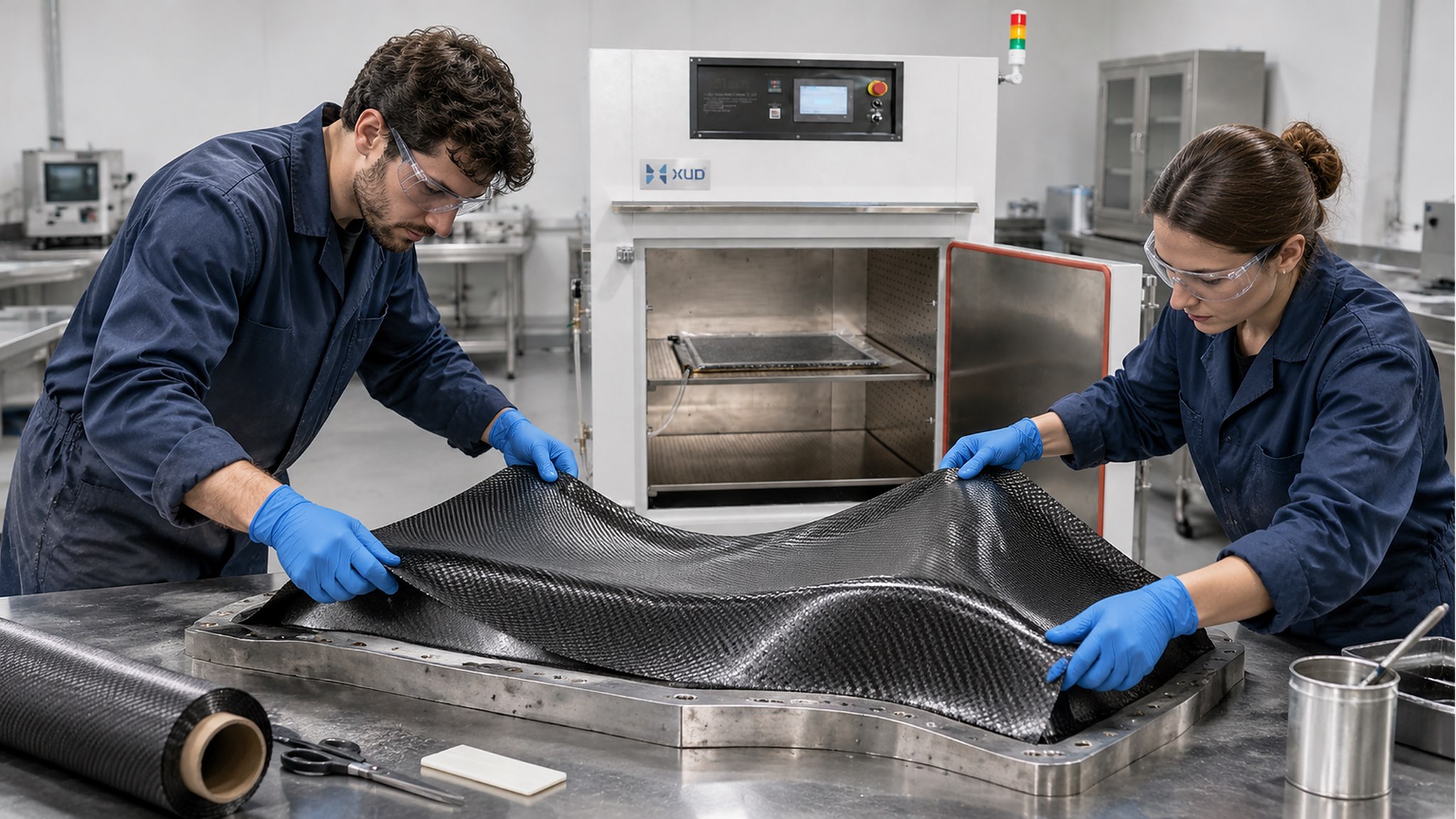
For example, a molded carbon fiber component may include:
- Curved outer surfaces and tight radii
- Deep corners or recessed areas
- Raised ribs and reinforcing sections
- Changes in laminate thickness
- Different surface orientations
These features affect how the prepreg is placed, how the vacuum bag conforms to the mold and how the part responds to heating.
A useful way to evaluate a complex component is to separate the process into three questions:
- Can the material be placed correctly? The laminate must follow the intended shape without unacceptable wrinkles, bridging or fiber distortion.
- Can the vacuum bag conform to the tooling? The bagging arrangement must provide suitable sealing and air paths around the geometry.
- Can the complete assembly follow the required thermal cycle? The part and tooling must receive suitable heating conditions according to the approved material process.
For the basic relationship between prepreg, temperature and curing conditions, see Part 01: How to Cure Carbon Fiber Prepreg in an Industrial Oven.
2. Mold and Tooling Support: The Foundation of Part Geometry
The mold or tooling supports the composite material and defines the final component shape. For complex parts, tooling design and support are particularly important because unsupported areas may move or deform during handling and processing.
Check the Mold Before Layup
Inspect the tooling surface for contamination, damage, foreign particles and areas that may affect material contact or surface finish.
For parts with deep contours or narrow features, check whether the tooling allows sufficient access for material placement and vacuum bag installation.
Consider Tooling Mass and Thermal Behavior
The mold is part of the heated assembly. Its material, thickness and mass can influence how quickly the complete setup responds to the oven's heating cycle.
A heavy mold may respond more slowly than a thin laminate. Therefore, the oven controller's displayed chamber temperature should not automatically be treated as the actual temperature of every point in the composite assembly.
For critical processes, discuss suitable temperature measurement and validation methods with the process engineer and equipment supplier.
3. Layup Challenges Around Curves and Corners
Complex geometry can make it difficult to position prepreg plies accurately. Material must follow the tooling surface while maintaining the intended fiber orientation and laminate structure.
Common areas requiring additional attention include:
- Tight corners where the material may resist conforming to the mold
- Deep recesses where access is limited
- Transitions between flat and curved surfaces
- Areas where laminate thickness changes
- Edges where excess material or local wrinkles may develop
Possible defects include wrinkles, fiber distortion, bridging and uneven material contact. These issues may originate during layup rather than during the oven heating stage.
Manufacturers should review the laminate sequence, ply dimensions, material handling method and tooling geometry before finalizing the curing process.
4. Vacuum Bagging for Complex-Shaped Carbon Fiber Parts
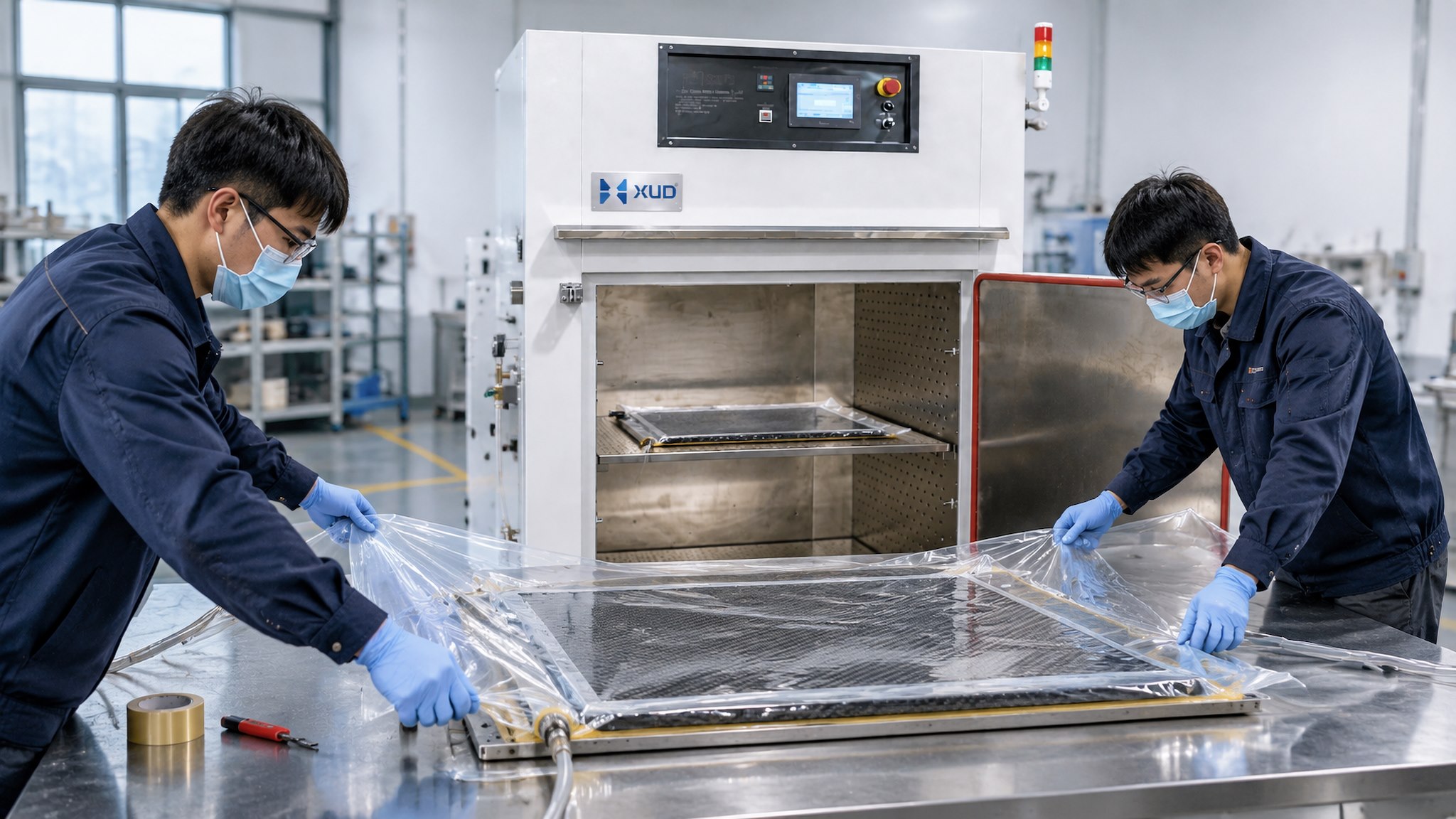
Vacuum bagging becomes more challenging when the workpiece includes deep curves, sharp transitions and recessed areas. The bag film must conform to the assembly while maintaining a suitable seal and vacuum path.
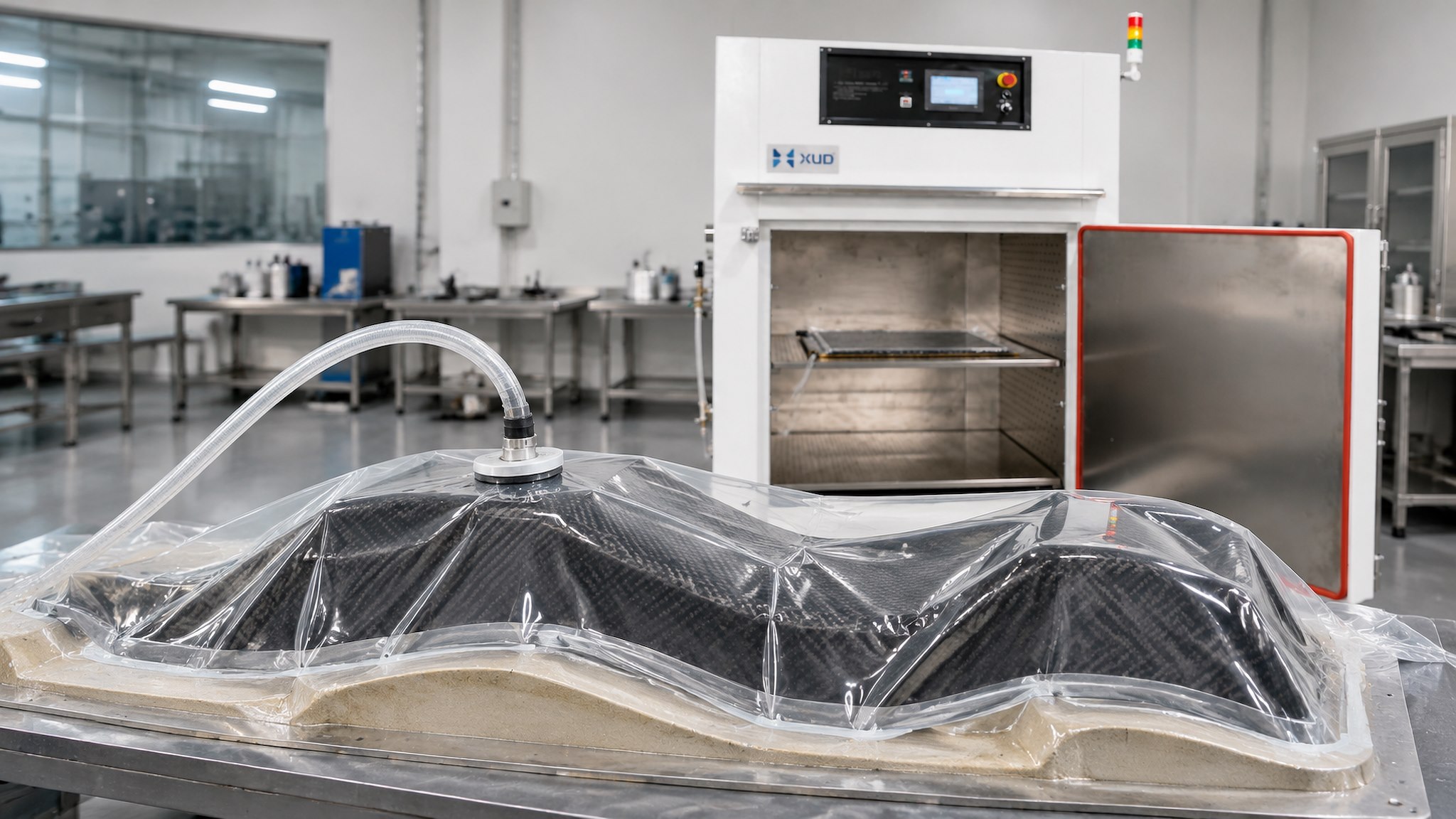
Watch for Bridging
Bridging occurs when the vacuum bag does not fully conform to a corner or recessed section. Instead of following the surface, the bag may span across the area and leave an unsupported space underneath.
This can prevent the intended pressure difference from acting uniformly on the laminate and may contribute to local defects.
Plan the Bagging Arrangement
Before sealing the bag, review the geometry and identify areas where folds, tight radii or changes in surface direction may create problems.
- Allow suitable bag film material for the part's contours.
- Inspect corners and recessed sections for bridging.
- Keep vacuum paths continuous according to the approved bagging design.
- Check sealant tape continuity around the tooling perimeter.
- Verify vacuum integrity before starting the heating cycle.
Vacuum bagging consumables must also be compatible with the curing temperature and resin system. Bag film, sealant tape, breather materials and hoses should be selected according to their technical specifications.
For a detailed explanation of bagging materials and leak checks, read Part 02: Vacuum Bagging Process for Carbon Fiber Composite Panels.
5. Airflow and Heat Distribution Around Complex Parts
Hot air circulation helps distribute heat inside an industrial curing oven. However, the shape and position of the load can influence local airflow conditions.
A large mold, a deep component or several closely arranged parts may obstruct or redirect airflow. This is why the chamber should be evaluated using the actual workpiece and tooling arrangement.
Avoid Treating Empty-Chamber Conditions as the Whole Story
An empty oven test does not necessarily represent the thermal conditions of a fully loaded production batch. Molds, support fixtures and workpieces all occupy space and influence the heating environment.
When discussing oven design, provide the manufacturer with photographs, drawings and loading information. This allows the chamber dimensions, circulation arrangement and loading layout to be considered together.
For repeat production, it is useful to define a consistent loading arrangement so that the parts are positioned in a repeatable way from batch to batch.
6. Thermal Lag and Thick Sections
Complex carbon fiber parts may contain sections with different thicknesses and tooling conditions. These areas do not always respond to heating at the same rate.
Thicker laminate sections and heavier tooling may take longer to approach the surrounding chamber temperature. This is commonly described as thermal lag.
If the curing cycle is evaluated only by the controller's chamber reading, the actual thermal response of the workpiece may be overlooked.
What Should Manufacturers Consider?
- Identify the thickest and most thermally demanding sections.
- Consider the mass and material of the mold or tooling.
- Review the required heating rate and holding time in the material TDS.
- Discuss whether workpiece temperature measurement is needed.
- Validate the thermal process using a representative part and loading arrangement when required.
Do not extend or modify the curing cycle simply to compensate for suspected thermal lag without process validation. Any changes must be evaluated against the material supplier's approved procedure.
7. Loading Arrangement and Batch Consistency
Even when the curing process is correct, inconsistent loading can make production difficult to repeat.
Complex-shaped parts may require dedicated supports, customized trays or specific orientations inside the chamber. The loading arrangement should prevent unwanted movement and provide sufficient clearance around the workpiece.
Before production, define:
- Part orientation inside the chamber
- Support and fixture positions
- Clearance between parts and chamber walls
- Vacuum hose routing and connection access
- Maximum number of parts per batch
For repeated production, document the loading arrangement and use the same validated configuration whenever possible. This helps reduce unnecessary process variation.
8. Common Problems and Practical Checks
When a complex carbon fiber component shows defects, the cause may be related to material handling, tooling, vacuum bagging, heating or several factors together.
| Observed Problem | Possible Factors to Check |
|---|---|
| Wrinkles around corners | Ply placement, material conformity and local bagging arrangement |
| Bridging in recessed areas | Bag film allowance, geometry and vacuum bag installation |
| Vacuum loss | Sealant tape, bag film, fittings, hoses and vacuum connections |
| Uneven curing results | Thermal lag, loading arrangement, tooling mass and process control |
| Part distortion | Tooling support, material behavior and cooling procedure |
This table is a troubleshooting starting point rather than a definitive diagnosis. The actual cause should be confirmed through process records, material specifications and inspection of the defective component.
9. Selecting an Industrial Oven for Complex-Shaped Parts
An industrial carbon fiber curing oven should be selected according to the complete production assembly rather than the component dimensions alone.
Important equipment considerations include:
- Temperature range: The operating range must cover the approved material curing cycle.
- Heating system: Electric heating and hot air circulation can provide a controlled heating environment.
- Chamber dimensions: The chamber must accommodate the component, mold, bagging materials and loading clearance.
- Vacuum connections: Internal vacuum ports can connect to an external vacuum pump for compatible vacuum-bagging processes.
- Loading structure: Shelves, trays, supports or customized arrangements may be required for different part shapes.
- Control requirements: Temperature programming and any additional monitoring functions should be specified before ordering.
It is equally important to understand the difference between an industrial oven and an autoclave. An oven provides controlled heating, while an autoclave can additionally apply controlled external pressure. A standard oven with vacuum ports does not replace an autoclave when the material process requires positive pressure.
Read Part 03: Composite Curing Oven vs. Autoclave for a more detailed equipment comparison.
Xinyuanda Customized Carbon Fiber Curing Oven
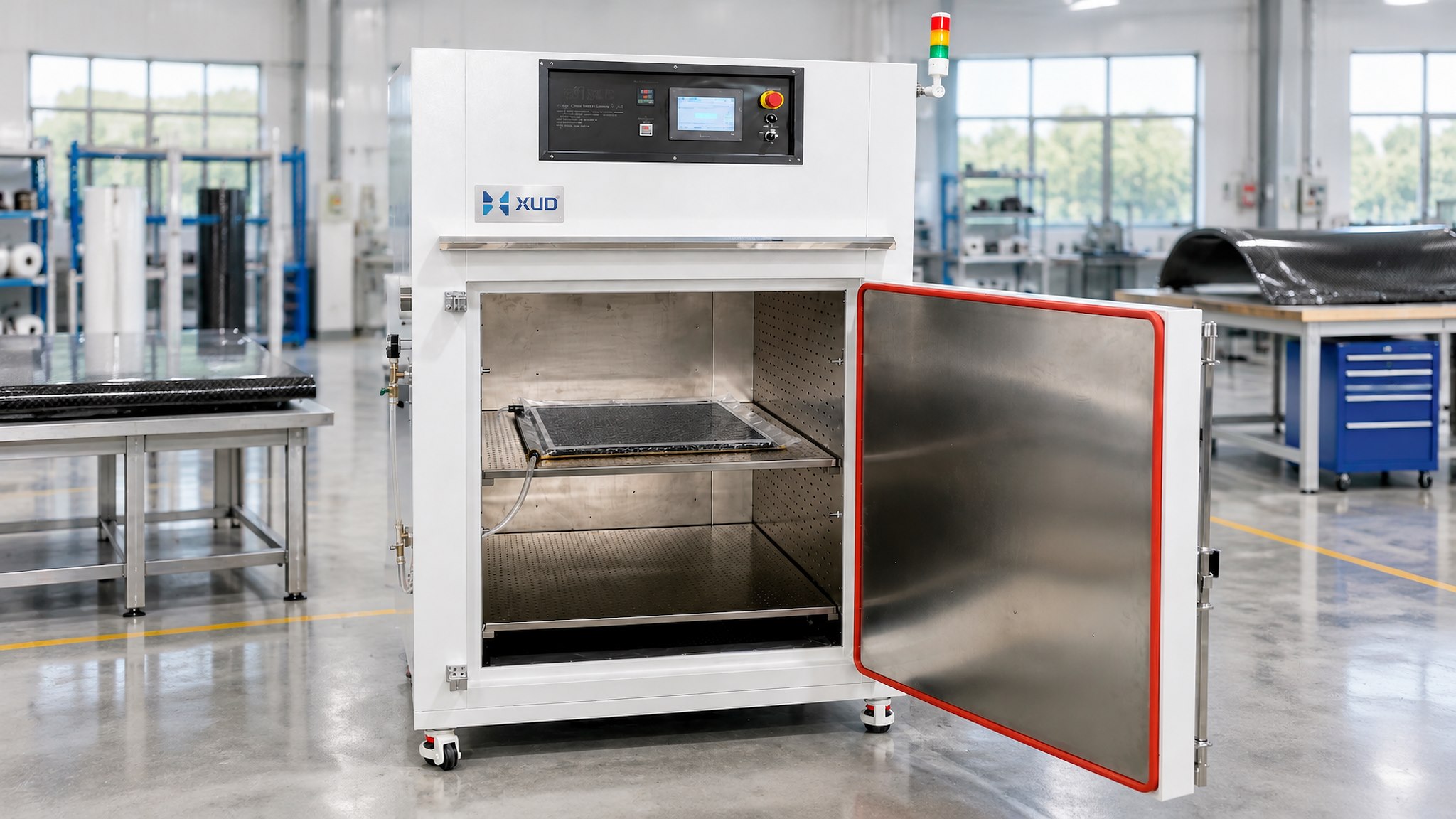
Xinyuanda provides industrial carbon fiber curing ovens with electric heating, hot air circulation and internal vacuum ports for external vacuum pump connection.
The maximum operating temperature is 250°C. Chamber dimensions, internal layout and vacuum port positions can be customized according to flat panels, complex-shaped composite parts and production requirements.
The external vacuum pump is not included as standard equipment unless specified in the quotation. The required temperature, heating rate, holding time and vacuum conditions must follow the material supplier's approved process.
View Xinyuanda Carbon Fiber Curing Oven →
10. Frequently Asked Questions
Q1: Can an industrial oven cure complex-shaped carbon fiber parts?
Yes, when the material is compatible with oven-based curing and the equipment chamber, tooling support, vacuum arrangement and thermal process meet the production requirements.
Q2: Why is vacuum bagging more difficult for complex-shaped parts?
Curves, tight corners and recessed areas can make it difficult for the bag film to conform to the tooling. Bridging, wrinkles and local leakage should be checked before heating.
Q3: Do complex parts require a larger curing oven?
Not always. Chamber size should be based on the complete assembly, including the component, mold, support fixtures, vacuum connections and loading clearance.
Q4: Does hot air circulation guarantee uniform curing?
Hot air circulation helps distribute heat inside the chamber, but actual workpiece temperature also depends on part geometry, tooling mass, loading conditions and the approved process cycle. Validation may be necessary for demanding applications.
Q5: Can Xinyuanda customize an oven for complex carbon fiber components?
Yes. Chamber dimensions, internal loading arrangements and vacuum port positions can be customized according to workpiece dimensions and production requirements.
Continue Reading: Carbon Fiber Curing Guide
Explore the complete series:
- Part 01 – How to Cure Carbon Fiber Prepreg in an Industrial Oven
- Part 02 – Vacuum Bagging Process for Carbon Fiber Composite Panels
- Part 03 – Composite Curing Oven vs. Autoclave
- Part 04 – What to Look for When Buying a Carbon Fiber Curing Oven
- Part 05 – How to Cure Complex-Shaped Carbon Fiber Composite Parts
- Part 06 – How to Choose a Curing Oven for Composite Panels
Need a Curing Oven for Complex Carbon Fiber Parts?
Share your component drawings, dimensions, material specifications and curing requirements with our team. We can discuss a customized oven structure and loading arrangement for your production process.
WhatsApp: +86 18998007076
Email: annalan@xudoven.com
What to Look for When Buying a Carbon Fiber Curing Oven
Related Article