Composite Curing Oven vs. Autoclave: Key Differences
Composite Curing Oven vs. Autoclave: Key Differences
Heating, Vacuum Bagging, Pressure Requirements and Process Selection
In This Guide
- The Basic Difference Between an Oven and an Autoclave
- Heating vs. Pressure: Two Different Functions
- How Vacuum Bagging Works with Each System
- Which Materials Can Be Cured in an Oven?
- Industrial Oven vs. Autoclave Comparison
- What an Industrial Oven Cannot Replace
- How to Choose the Right Equipment
- Xinyuanda Carbon Fiber Curing Oven
- Frequently Asked Questions
1. The Basic Difference Between a Composite Curing Oven and an Autoclave
Both composite curing ovens and autoclaves are used in carbon fiber composite manufacturing. They provide controlled heating environments, but their equipment structures and processing capabilities are different.
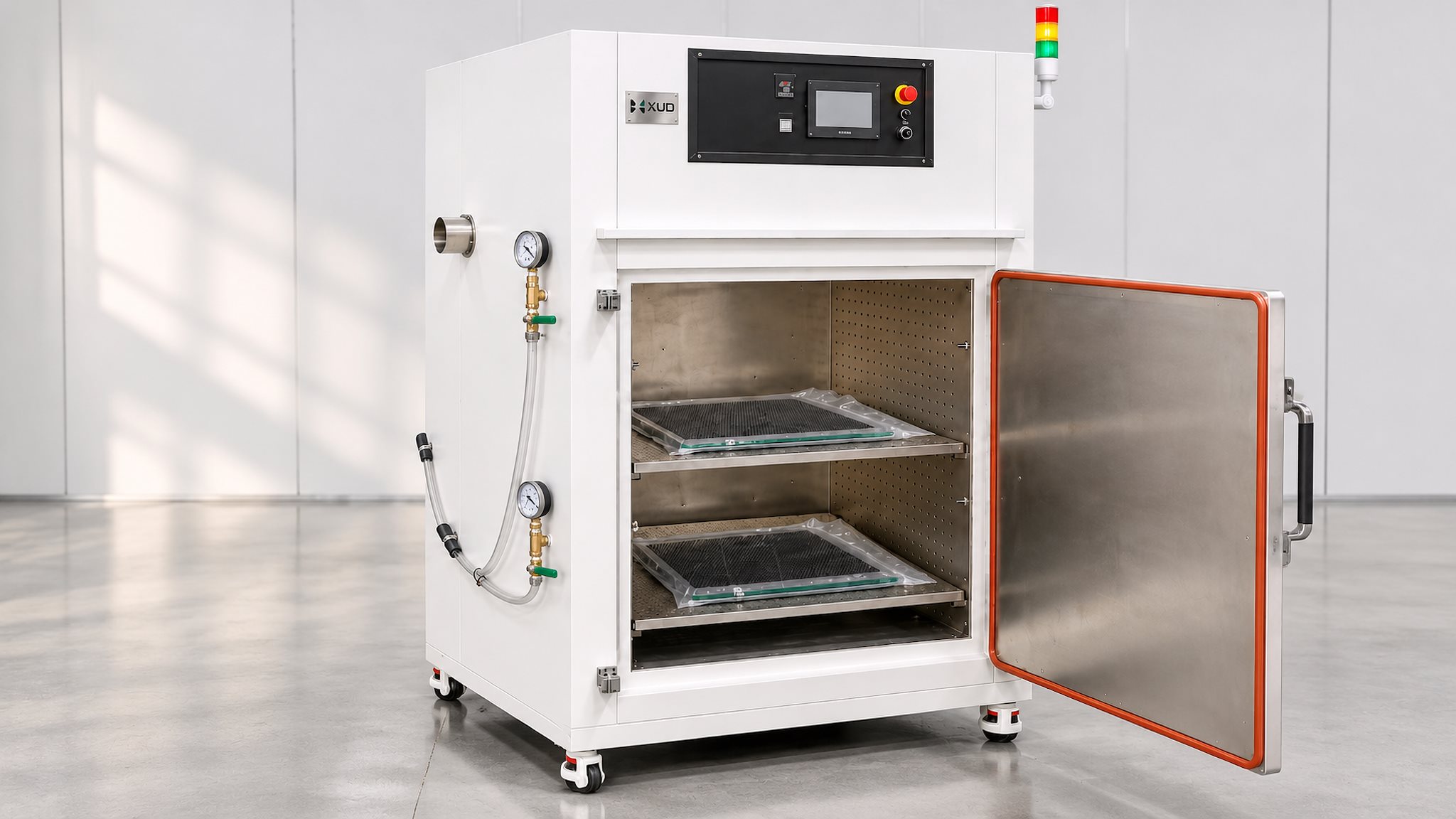
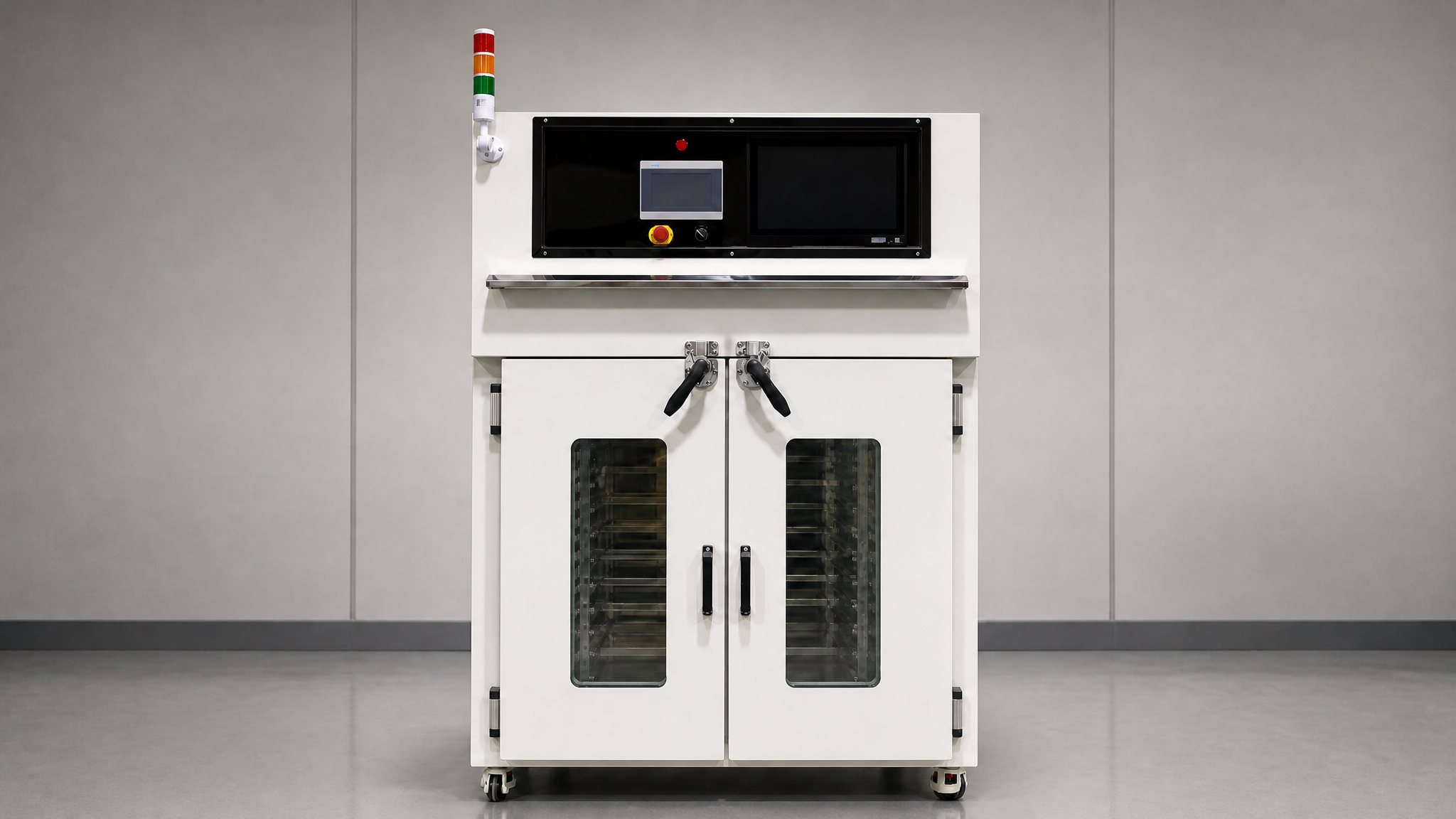
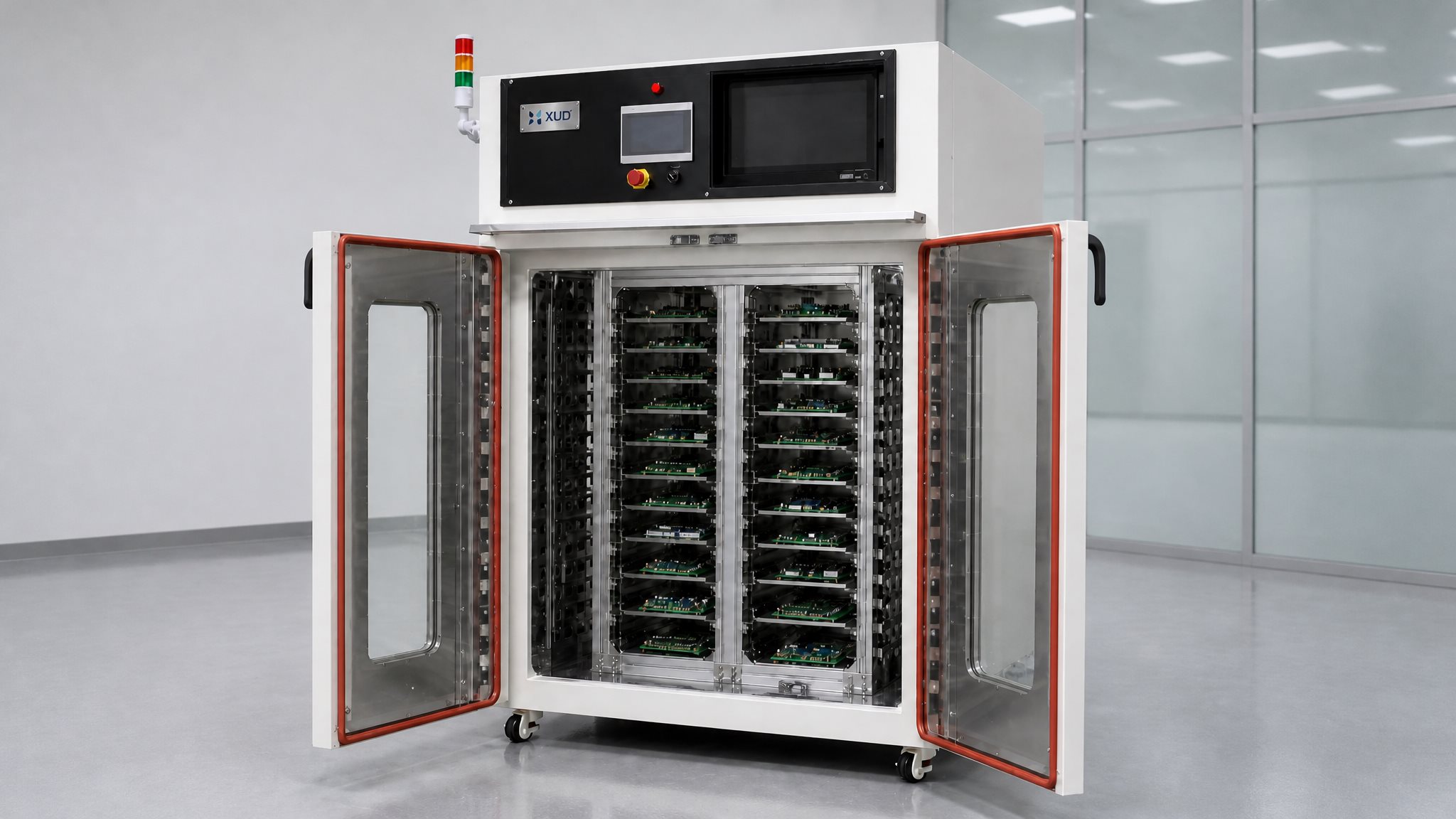
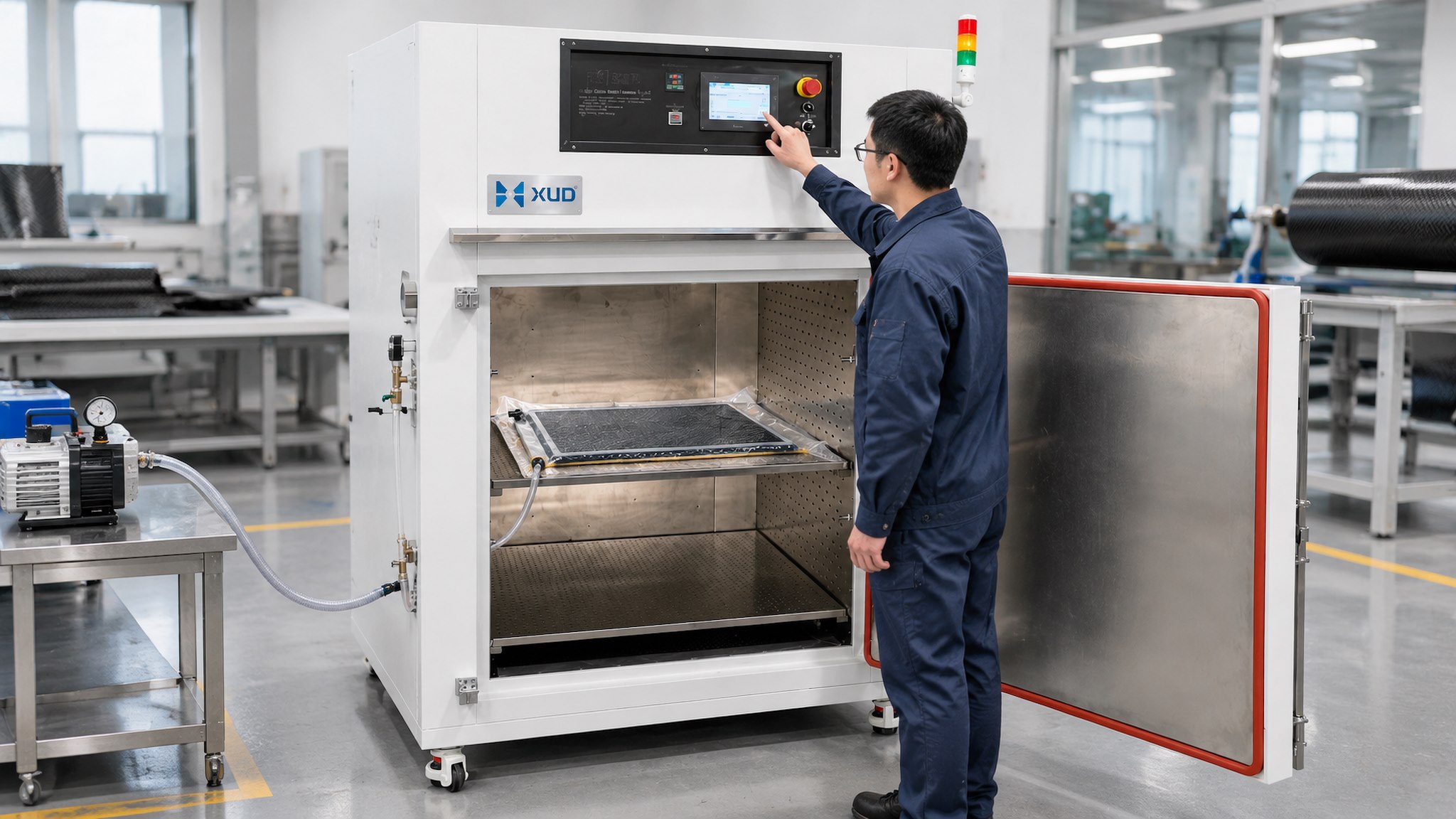
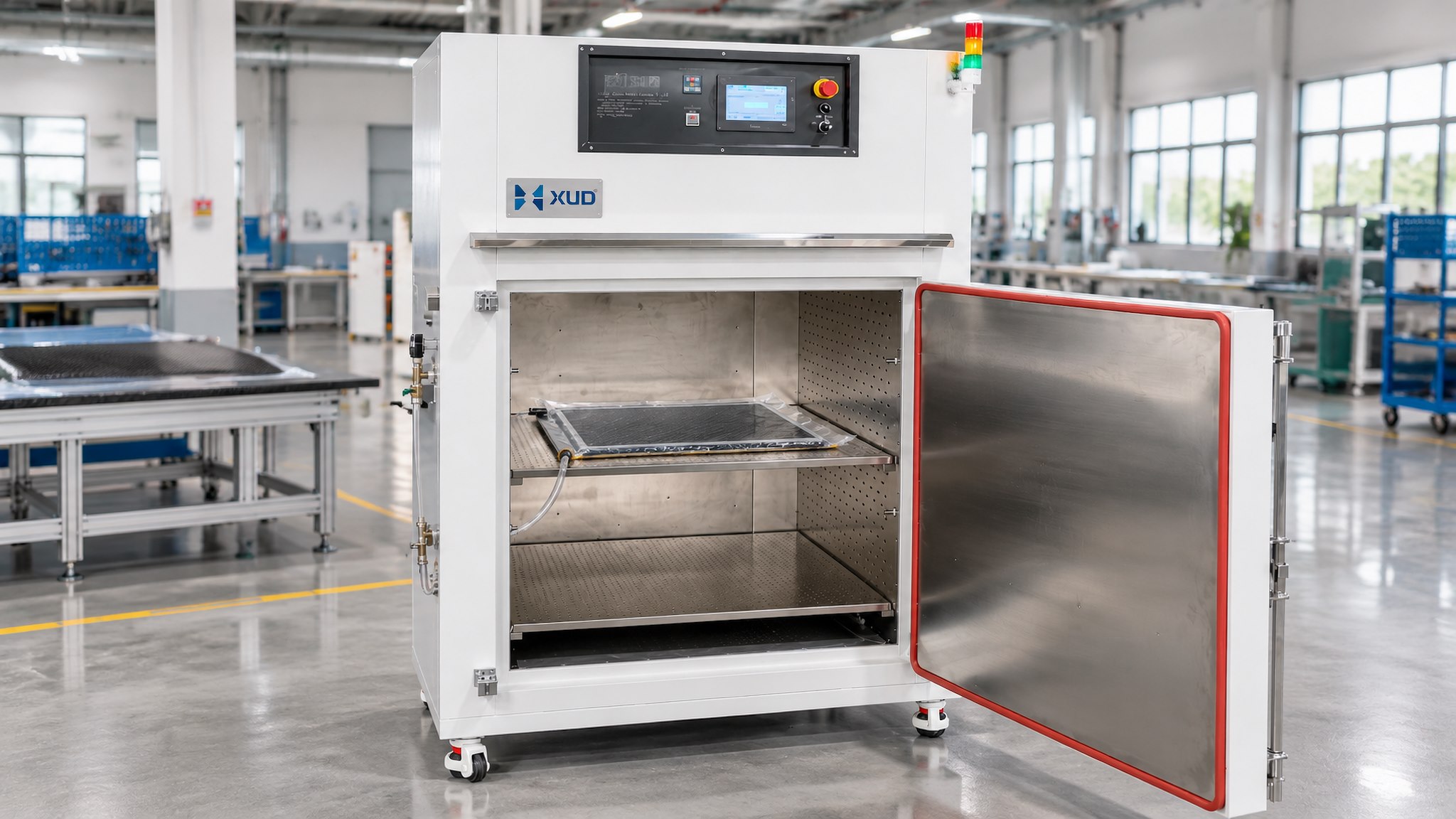
A composite curing oven is designed primarily to heat a workpiece according to a specified temperature cycle. Depending on its configuration, it can also include vacuum connection ports for use with an external vacuum bagging system.
An autoclave is a pressure-rated vessel designed to provide controlled heating and additional external pressure during processing. It is commonly used with vacuum-bagged composite components.
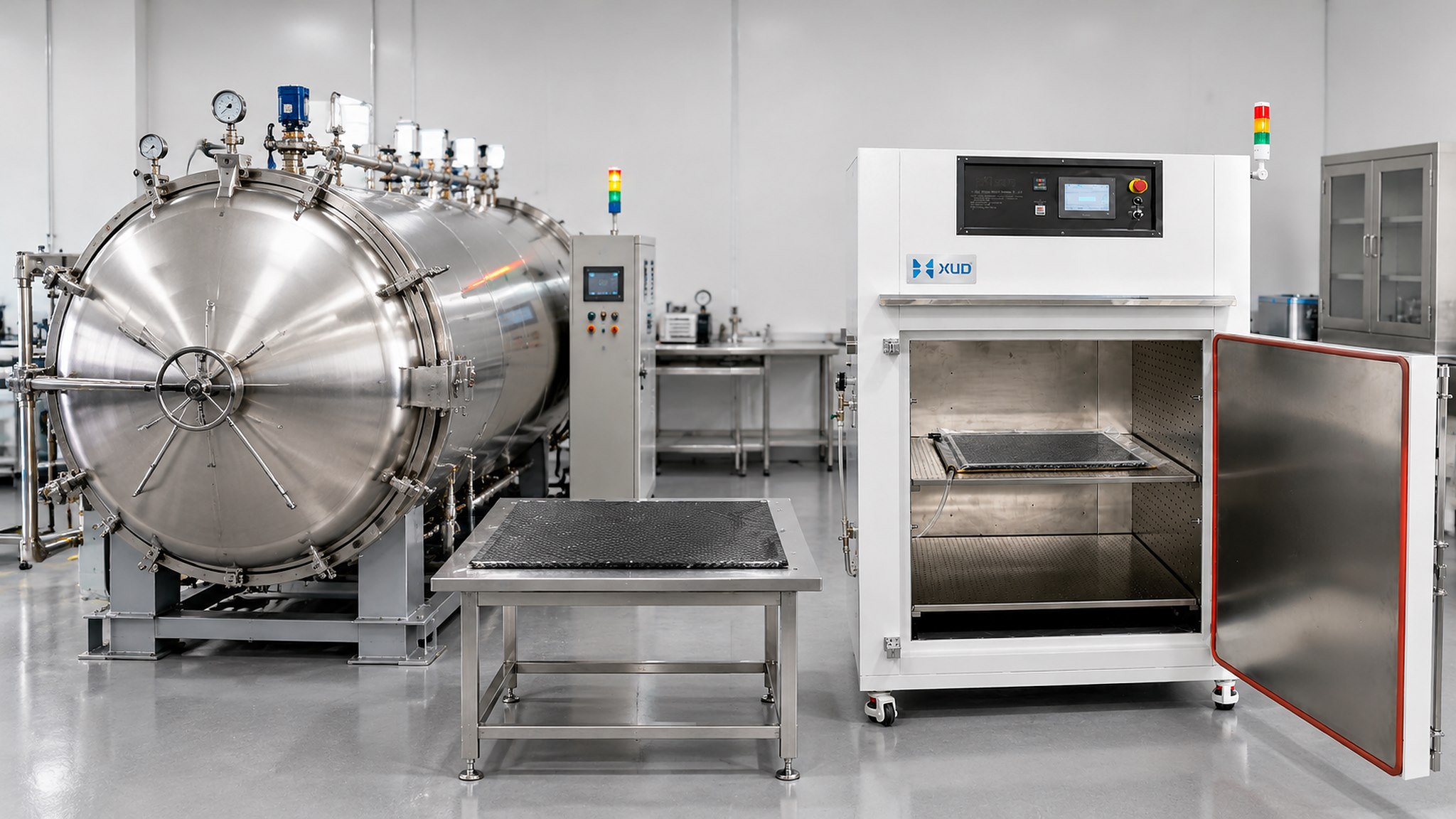
The most important difference is therefore not simply the shape or size of the equipment. It is whether the process requires external positive pressure in addition to heating and vacuum bagging.
For an introduction to prepreg processing and oven-based curing, read Part 01: How to Cure Carbon Fiber Prepreg in an Industrial Oven.
2. Heating and Pressure: Two Different Process Functions
One common misunderstanding in composite equipment selection is treating temperature and pressure as if they were the same process capability. In fact, they perform different functions.
What does heating do?
Heat activates the resin reaction in the composite material. The curing temperature, heating rate and holding time determine how the resin progresses through its specified curing cycle.
Both an industrial oven and an autoclave can provide controlled heating. The actual thermal performance depends on equipment design, loading conditions, temperature monitoring and the required process cycle.
What does external pressure do?
In an autoclave, external pressure is applied around the vacuum-bagged component. This additional pressure can help consolidate the laminate and support the processing requirements of materials designed for autoclave curing.
A standard industrial oven does not provide this controlled positive pressure. Even when it has vacuum ports, those connections are used to remove air from the vacuum bag through an external pump. They do not turn the oven chamber into a pressurized vessel.
Vacuum bagging creates a pressure difference across the bag. An autoclave can additionally apply controlled positive pressure around the bagged component. These are different functions and should not be treated as interchangeable.
If the material specification requires a pressure cycle, a standard oven with vacuum ports is not an equivalent replacement. Confirm this requirement before requesting an equipment quotation.
3. How Vacuum Bagging Works with an Oven or Autoclave
Vacuum bagging is commonly used in both oven-based composite processing and autoclave processing. The basic bagging principle is similar, but the surrounding equipment provides different operating conditions.
Vacuum bagging with an industrial oven
The composite layup is prepared on tooling and sealed inside a vacuum bag. A vacuum line connects the bag to an external pump through a suitable connection point. The oven then supplies the required heat while the vacuum system operates according to the approved process.
This arrangement may be suitable for prepreg systems specifically designed for oven-based vacuum bagging, including certain out-of-autoclave materials.
Vacuum bagging inside an autoclave
The component is also prepared in a vacuum bag, but the assembly is placed inside a pressure-rated vessel. During the curing cycle, the autoclave provides controlled heat and external pressure according to the material's processing specification.
Process Capability at a Glance
Vacuum bag + external vacuum pump + heated oven chamber
Vacuum bag + vacuum system + heated pressure vessel
Simplified process comparison. Actual process design depends on the material and equipment configuration.
The two systems should therefore be evaluated against the prepreg manufacturer's approved process rather than judged only by whether both use vacuum bags.
For more details about bagging materials, sealing and leak checks, read Part 02: Vacuum Bagging Process for Carbon Fiber Composite Panels.
4. Which Carbon Fiber Materials Can Be Cured in an Industrial Oven?
Not all carbon fiber prepreg materials have the same processing requirements. Some are designed for oven curing with vacuum bagging, while others require autoclave pressure to meet their specified quality and performance requirements.
Out-of-autoclave (OOA) prepregs are developed for processing without the additional external pressure of an autoclave, subject to the material manufacturer's specified procedure. Depending on the product, an oven and vacuum bagging system may be sufficient.
However, the term OOA should not be interpreted as meaning that every prepreg can be cured in any ordinary oven. The exact resin system, laminate design, tooling and curing cycle still matter.
Questions to ask the material supplier
- Is the prepreg approved for oven-only or vacuum-bag-only curing?
- Does the specified process require additional external pressure?
- What are the required curing temperature and holding time?
- Is a particular vacuum condition required during the cycle?
- Are there restrictions on laminate thickness, geometry or part dimensions?
- What cooling and demolding conditions must be followed?
Before comparing oven and autoclave quotations, obtain the prepreg technical data sheet and confirm the approved processing route. This prevents buying equipment that cannot meet the material's actual requirements.
5. Industrial Composite Curing Oven vs. Autoclave: Comparison
The following table summarizes the main differences from an equipment and process perspective.
| Comparison | Industrial Curing Oven | Autoclave |
|---|---|---|
| Main Function | Controlled heating | Controlled heating and external pressure |
| Vacuum Bagging | Possible with suitable vacuum ports and external pump | Commonly used in composite processing |
| Positive Pressure | Not provided by a standard oven | Controlled pressure in a pressure-rated vessel |
| Material Compatibility | Materials approved for oven curing | Materials requiring autoclave processing |
| Equipment Structure | Heated chamber | Pressure-rated vessel |
| Vacuum Pump | External pump can be connected | Vacuum system arranged for autoclave operation |
| Equipment Selection Basis | Temperature, airflow, chamber and vacuum arrangement | Temperature, pressure, vessel capacity and process requirements |
Neither system is universally better. The right choice depends on the material specification, product quality requirements, production volume and validated process route.
6. What an Industrial Curing Oven Cannot Replace
Industrial ovens can be a practical solution for many compatible composite curing applications. However, it is important to understand their limitations before making an equipment decision.
An oven does not provide autoclave pressure
A standard industrial oven is not designed as a pressure vessel. Vacuum ports allow the external pump to remove air from a sealed bag, but they do not create controlled positive pressure around the workpiece.
An oven cannot change the material's approved process
If a prepreg supplier specifies autoclave processing, using an oven without the required pressure does not make the process equivalent. The material and process must be evaluated by the responsible engineering team.
An oven's maximum temperature does not guarantee curing quality
A maximum temperature rating describes the equipment's operating capability. It does not guarantee that a particular part will reach the correct temperature uniformly or that the resin will complete its required curing reaction.
Vacuum connections do not guarantee a leak-free bag
The bagging assembly, consumables, seals, fittings and external vacuum system must still be correctly designed and inspected. The oven provides the heating environment and connection arrangement, not automatic correction of bagging defects.
Key takeaway: Equipment capability and material process approval must be checked separately. A suitable oven configuration cannot compensate for an incompatible curing procedure.
7. How to Choose Between an Industrial Oven and an Autoclave
For a composite manufacturer, the selection process should begin with the product and material requirements rather than the equipment price alone.
An oven-based solution may be suitable when:
- The prepreg or resin system is approved for oven-based curing.
- The specified process does not require additional autoclave pressure.
- The required heating cycle can be achieved by the proposed oven.
- The chamber can accommodate the workpiece, tooling and loading arrangement.
- Vacuum bagging can be implemented with suitable external connections.
An autoclave may be required when:
- The material supplier specifies autoclave processing.
- The process requires additional controlled external pressure.
- The component specification requires a validated autoclave process.
- The manufacturing process has been qualified around autoclave pressure and temperature conditions.
Information to prepare before requesting a quotation
- Prepreg or resin material specification.
- Approved curing temperature and time cycle.
- Whether additional external pressure is required.
- Maximum workpiece and mold dimensions.
- Number of parts per batch.
- Vacuum port quantity and external pump requirements.
- Temperature monitoring and process recording requirements.
Providing these details helps the equipment manufacturer evaluate whether an industrial oven is suitable and how the chamber, airflow and vacuum connections should be configured.
8. Xinyuanda Carbon Fiber Curing Oven Solution
For composite manufacturers whose materials are compatible with oven-based curing, Xinyuanda provides customized industrial curing ovens designed around specific workpiece dimensions and process requirements.
Current Equipment Configuration
- Maximum operating temperature: Up to 250°C.
- Heating method: Electric heating.
- Air circulation: Hot air circulation.
- Vacuum connection: Internal vacuum ports for an external vacuum pump.
- Workpiece types: Flat composite panels and complex-shaped parts.
- Customization: Chamber size and equipment arrangement can be discussed according to the application.
The external vacuum pump is not included as standard equipment unless specified in the quotation.
The equipment should be selected only after confirming that the material's approved process is compatible with oven-based curing. The maximum operating temperature of 250°C is an equipment capability, not a recommended curing temperature for every prepreg.
For a customized proposal, share your material data sheet, workpiece drawings, curing cycle and vacuum requirements with our engineering team.
9. Frequently Asked Questions
Q1: What is the main difference between a composite curing oven and an autoclave?
A standard composite curing oven provides controlled heating. An autoclave provides controlled heating and additional external pressure in a pressure-rated vessel.
Q2: Can a curing oven with vacuum ports replace an autoclave?
Only for materials and processes approved for oven-based vacuum bagging. Vacuum ports do not provide the additional positive pressure available in an autoclave.
Q3: What is an out-of-autoclave carbon fiber prepreg?
It is a prepreg material designed for processing without an autoclave's additional external pressure, provided that its specified oven-based processing procedure is followed.
Q4: Does vacuum bagging provide the same pressure as an autoclave?
No. Vacuum bagging creates a pressure difference across the bag. An autoclave can apply additional controlled positive pressure around the bagged component.
Q5: Does the Xinyuanda carbon fiber curing oven include a vacuum pump?
The described configuration includes internal vacuum ports for connection to an external vacuum pump. The pump is not included as standard equipment unless it is specifically listed in the quotation.
Conclusion
Choosing between a composite curing oven and an autoclave is fundamentally a process decision. Both can provide controlled heating, but only an autoclave provides the additional controlled external pressure associated with autoclave processing.
An industrial oven with vacuum connections can be a practical solution for prepreg systems approved for oven-based vacuum bagging. However, it should not be considered a universal substitute for an autoclave.
The best starting point is always the material supplier's approved curing procedure. Once the process requirements are clear, equipment capacity, airflow, vacuum connections and chamber dimensions can be evaluated accurately.
Carbon Fiber Curing Guide
01. How to Cure Carbon Fiber Prepreg in an Industrial Oven
02. Vacuum Bagging Process for Carbon Fiber Composite Panels
03. Composite Curing Oven vs. Autoclave: Key Differences — You are reading this article
04. What to Look for When Buying a Carbon Fiber Curing Oven
05. How to Cure Complex-Shaped Carbon Fiber Composite Parts
06. How to Choose a Curing Oven for Composite Panels
Looking for a Carbon Fiber Curing Oven?
Share your composite material specifications, workpiece dimensions and curing requirements. Our team can help evaluate a suitable customized oven configuration.
WhatsApp: +86 18998007076
Email: annalan@xudoven.com
Vacuum Bagging Process for Carbon Fiber Composite Panels
Related Article