What to Look for When Buying a Carbon Fiber Curing Oven
What to Look for When Buying a Carbon Fiber Curing Oven
A Practical Equipment Selection Guide for Composite Manufacturers
Choosing a carbon fiber curing oven is not simply a matter of comparing maximum temperatures or chamber dimensions. The equipment must match the resin system, workpiece geometry, vacuum bagging method and production requirements.
An oven that reaches the required temperature may still be unsuitable if its loading arrangement is inconvenient, its airflow does not fit the process, or its vacuum connections cannot accommodate the planned bagging setup.
This guide explains the equipment factors manufacturers should evaluate before requesting a quotation. It also provides a practical checklist to help buyers describe their actual curing requirements.
In This Guide
- Start with the Curing Process
- Temperature Range and Control
- Heating Method and Air Circulation
- Vacuum Connections and Bagging Requirements
- Chamber Size and Workpiece Loading
- Control System and Process Monitoring
- Customization and Manufacturer Evaluation
- Pre-Purchase Checklist
- Xinyuanda Carbon Fiber Curing Oven
- Frequently Asked Questions
1. Start with the Curing Process, Not the Oven Model
Before comparing equipment, identify what the composite material actually requires. Carbon fiber prepreg systems can have different curing temperatures, heating rates, holding times and vacuum requirements.
Two products made from carbon fiber may require very different processing conditions because their resin formulations, laminate thicknesses and tooling arrangements are different.
Before contacting an oven manufacturer, collect the following information:
- Prepreg or resin system and its technical data sheet (TDS)
- Required curing temperature and holding time
- Recommended heating rate and cooling procedure
- Whether vacuum bagging is required
- Whether the material requires additional external pressure
- Workpiece dimensions, thickness and shape
For a more detailed explanation of prepreg processing, see Part 01: How to Cure Carbon Fiber Prepreg in an Industrial Oven.
2. Temperature Range and Control
Temperature capability is one of the first specifications buyers compare, but it should be evaluated in relation to the material's actual curing cycle.
Maximum Operating Temperature
The oven's maximum operating temperature should cover the required process temperature with an appropriate operating margin. However, a higher maximum rating does not automatically mean better curing quality.
For example, an oven with a maximum operating temperature of 250°C can accommodate compatible materials whose curing requirements fall within its operating range. It does not mean that every carbon fiber prepreg should be cured at 250°C.
Temperature Uniformity
Temperature distribution inside the chamber matters when several panels or components are processed together. Differences in heating conditions may affect resin behavior and final product consistency.
Ask the manufacturer how temperature uniformity is evaluated, under what loading conditions the data is obtained, and whether the test conditions represent your actual production setup.
Workpiece Temperature Versus Chamber Temperature
The temperature displayed by the oven controller is not necessarily identical to the temperature at every point inside a thick composite part or its mold. Part thickness, tooling mass and loading arrangement can influence thermal response.
For demanding processes, discuss whether additional workpiece temperature measurement or process validation is required.
3. Heating Method and Air Circulation
The heating system provides the energy needed to follow the specified curing cycle. Air circulation influences how heat is distributed throughout the working chamber.
Electric heating is a practical option for many industrial composite curing applications. When combined with hot air circulation, it helps distribute heat around loaded workpieces.
However, airflow design should be considered alongside workpiece geometry. Large molds, closely arranged panels or complex-shaped components may influence how air moves around the load.
When discussing airflow with a manufacturer, explain:
- Whether the workpieces are flat panels or three-dimensional parts
- Whether multiple components are cured in one batch
- How the molds and support fixtures are arranged
- Whether any surfaces must be protected from direct airflow
- What temperature consistency the process requires
A suitable chamber and circulation arrangement should be evaluated using the intended loading configuration rather than an empty oven alone.
4. Vacuum Connections and Bagging Requirements
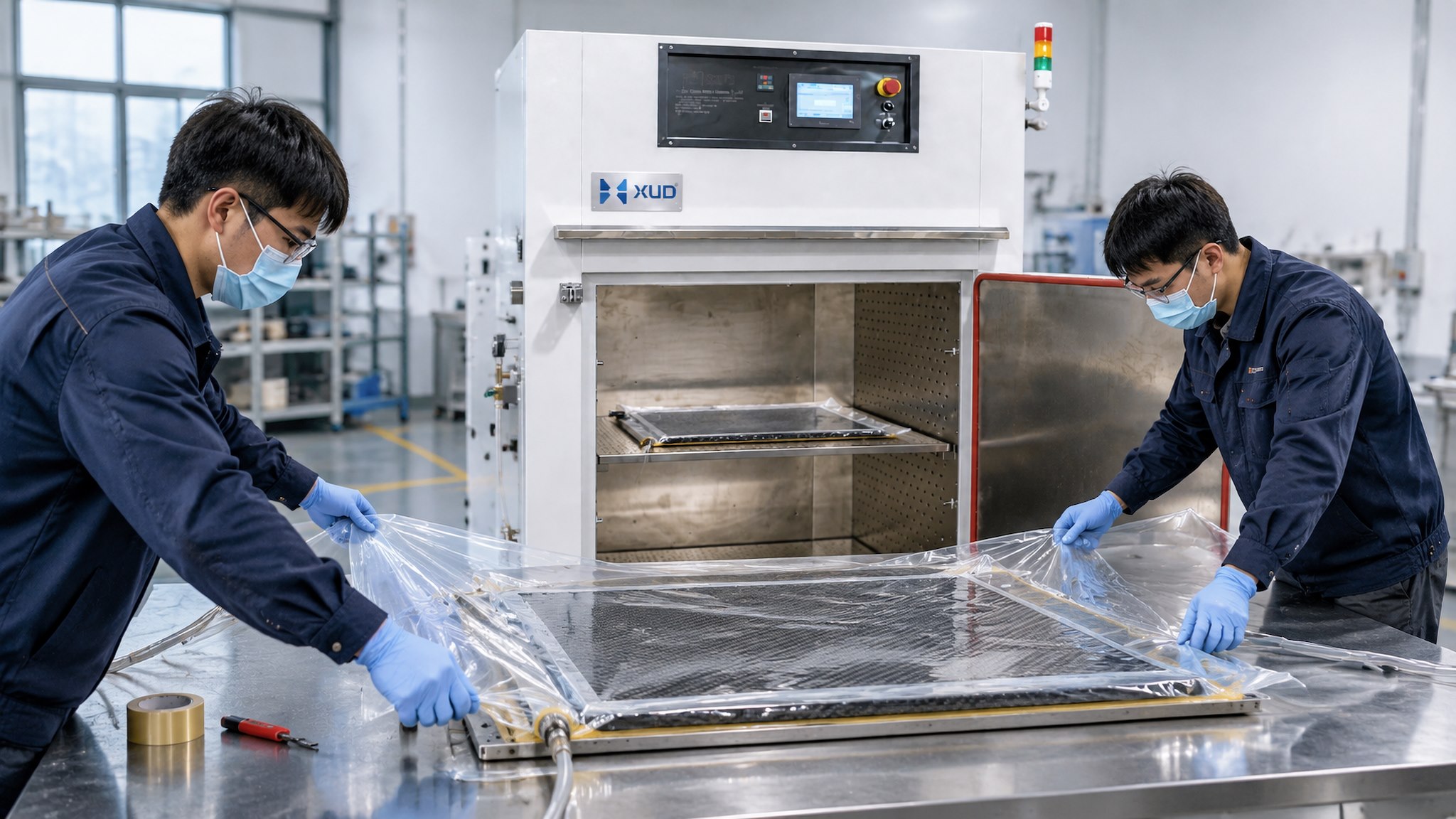
Vacuum bagging is commonly used in composite processing to consolidate the laminate and remove air from the bagged assembly. If your production process uses oven-based vacuum bagging, the oven configuration should support the planned vacuum connections.
When evaluating a curing oven, clarify the following details:
- Whether vacuum ports are required inside the chamber
- How many vacuum lines may be needed
- Where the ports should be positioned
- What hose and fitting temperature ratings are required
- Whether the external vacuum pump is supplied separately or included in the quotation
For a detailed explanation of bagging materials, vacuum connections and leak checks, read Part 02: Vacuum Bagging Process for Carbon Fiber Composite Panels.
Also compare the process requirements with Part 03: Composite Curing Oven vs. Autoclave before selecting equipment.
5. Chamber Size and Workpiece Loading
Chamber dimensions should be determined by the actual workpiece and tooling, not just the nominal product dimensions.
A carbon fiber panel may be relatively thin, but its mold, support frame, vacuum bag and connection hoses can require additional working space.
For complex-shaped parts, the maximum external dimensions alone are not enough. Consider the part's orientation, protruding sections, support points and the space needed for loading and unloading.
Think About the Complete Load
Before confirming the chamber size, prepare a simple loading drawing or photograph showing:
- Workpiece length, width and height
- Tooling or mold dimensions
- Required clearance around each component
- Number of parts processed per batch
- Loading direction and handling method
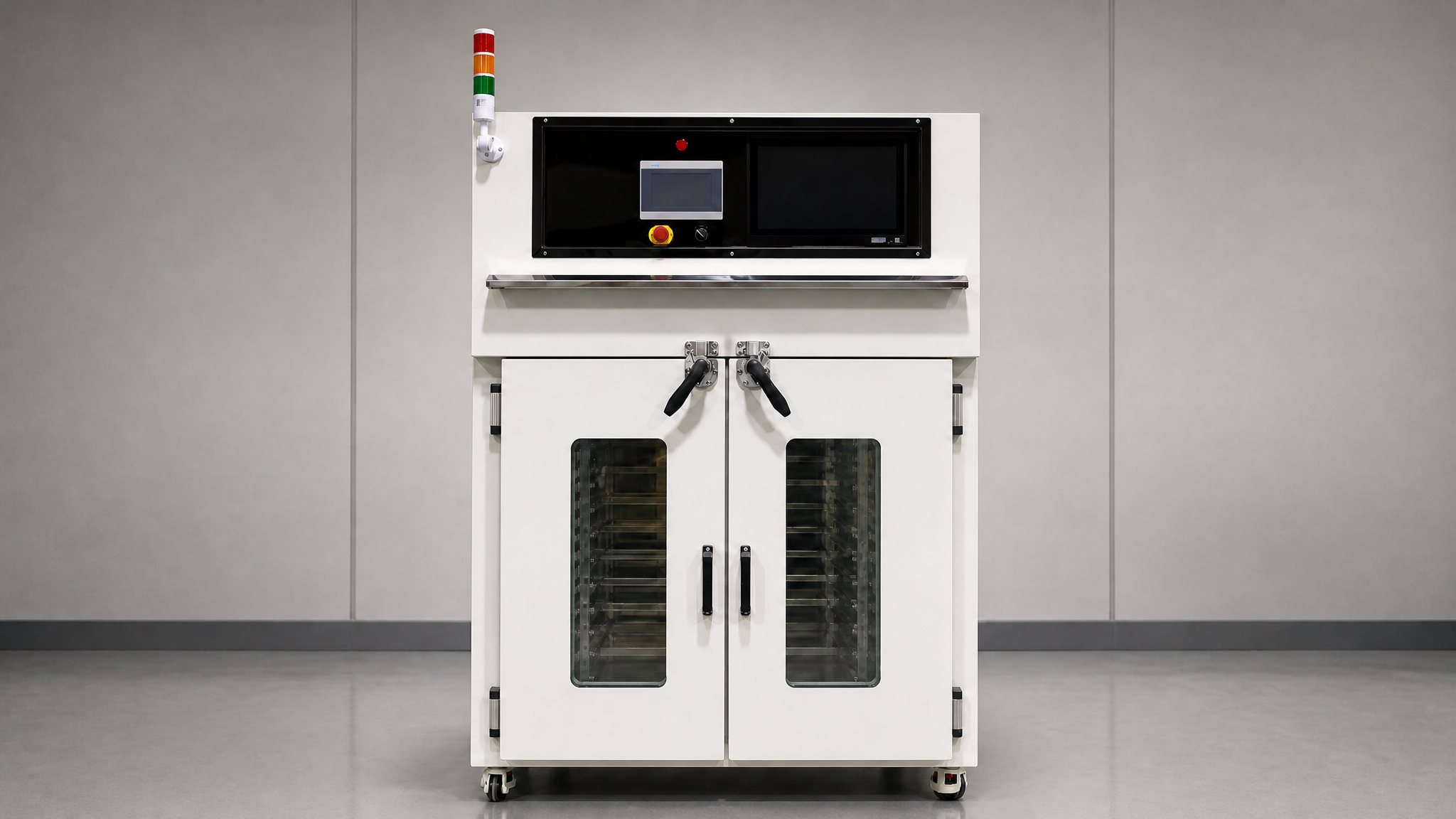
For larger or heavier components, also discuss shelves, trays, carts or customized support arrangements. The selected structure should safely accommodate the total load.
6. Control System and Process Monitoring
A curing oven should provide a control system suitable for the required heating process. Buyers should discuss how temperature settings, heating stages, holding periods and operating records will be managed.
Depending on the production requirements, useful items to discuss include:
- Programmable temperature control
- Multi-stage heating and holding settings
- Temperature display and operating status
- Over-temperature protection
- Alarm and abnormal-condition handling
- Additional temperature measurement requirements
Do not assume that every oven automatically includes data logging, multiple workpiece thermocouples or vacuum monitoring. Confirm these functions in the technical quotation.
7. Customization and Manufacturer Evaluation
Carbon fiber products vary considerably in shape, size and processing requirements. A customized oven may therefore be more suitable than selecting a standard chamber without considering the production process.
When evaluating an equipment manufacturer, ask whether the supplier can discuss and configure:
- Chamber dimensions and insulation structure
- Heating capacity and air circulation arrangement
- Vacuum port quantity and installation positions
- Internal loading layout and support fixtures
- Control requirements and safety configuration
- Electrical specifications and installation conditions
A reliable supplier should understand your material and process requirements before recommending a machine configuration. A quotation based only on oven dimensions and maximum temperature may leave important process details unresolved.
8. Pre-Purchase Checklist: What to Send the Oven Manufacturer
To receive a more accurate technical proposal, prepare the following information before requesting a quotation.
| Information | What to Provide |
|---|---|
| Material | Prepreg or resin system and TDS |
| Curing cycle | Temperature, heating rate, holding time and cooling requirements |
| Workpiece | Dimensions, thickness, shape and photographs |
| Tooling | Mold dimensions, weight and support requirements |
| Vacuum process | Vacuum bagging requirements and connection details |
| Production | Batch quantity and expected production frequency |
| Site conditions | Available space and power supply |
This information helps the manufacturer assess the chamber size, heating arrangement, vacuum connection layout and other necessary options before preparing a quotation.
9. Xinyuanda Carbon Fiber Curing Oven Solution
Xinyuanda provides customized industrial carbon fiber curing ovens for compatible composite materials and manufacturing processes.
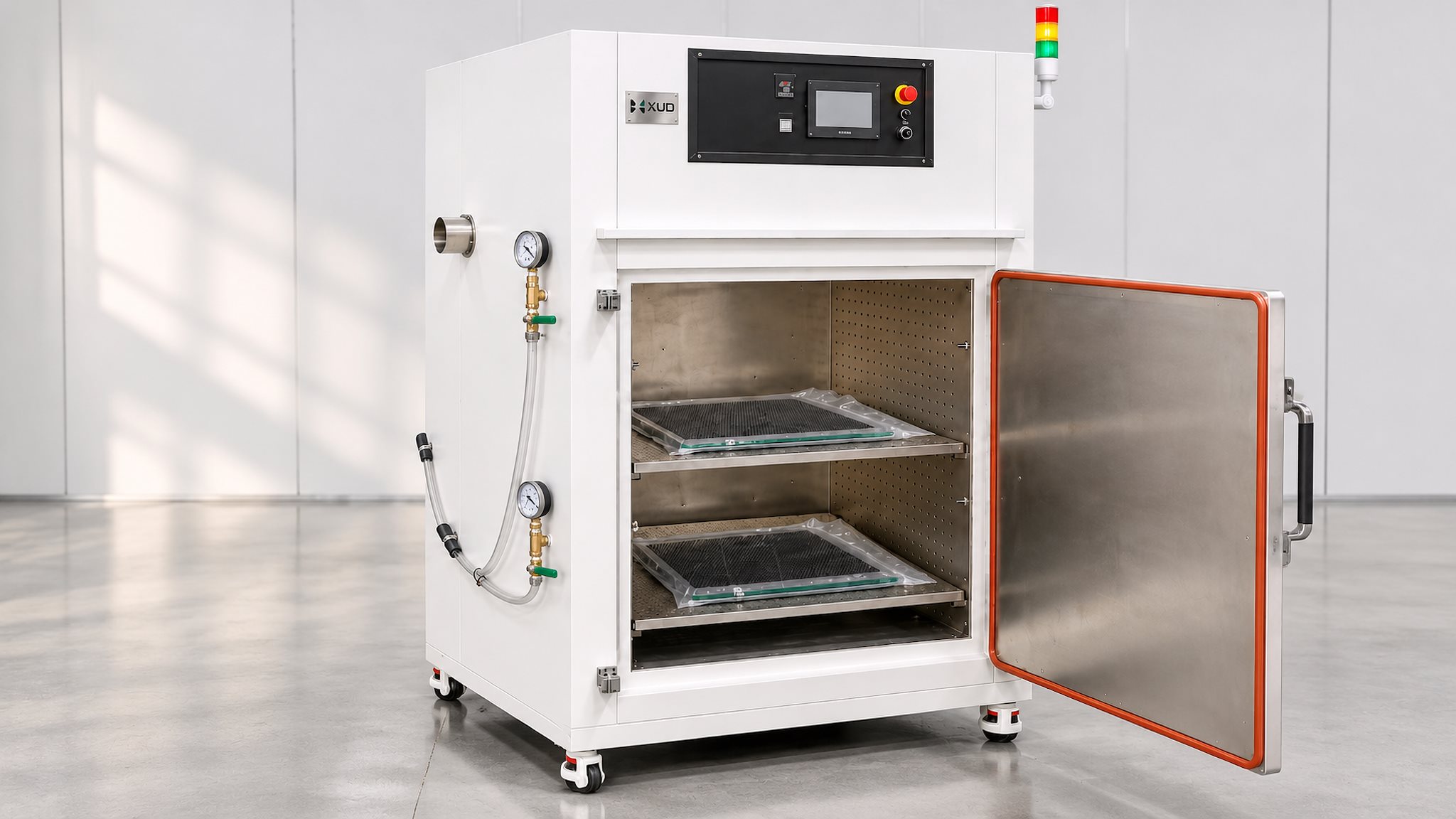
Our carbon fiber curing oven is configured with electric heating, hot air circulation and internal vacuum ports for connection to an external vacuum pump. The maximum operating temperature is 250°C.
The chamber dimensions, internal loading arrangement and vacuum port positions can be customized according to the workpiece and production requirements. The equipment can be designed for flat composite panels as well as complex-shaped components.
The external vacuum pump is not included as standard equipment unless specified in the quotation. Actual curing temperature, heating rate, holding time and vacuum conditions should follow the material supplier's approved process.
Explore Xinyuanda Carbon Fiber Curing Oven →
10. Frequently Asked Questions
Q1: What temperature should a carbon fiber curing oven reach?
The required temperature depends on the prepreg or resin system. Select an oven whose operating range covers the approved curing cycle. A 250°C maximum rating does not mean every material should be cured at that temperature.
Q2: Does a carbon fiber curing oven need vacuum ports?
If your process uses vacuum bagging during oven curing, vacuum ports can provide connections for an external vacuum system. The number and positions should be determined by the bagging arrangement.
Q3: Is a vacuum pump normally included?
Not necessarily. Confirm whether the pump, hoses, fittings and vacuum monitoring equipment are included in the quotation. Xinyuanda's standard carbon fiber curing oven provides internal vacuum ports for external pump connection.
Q4: Can one oven cure both flat panels and complex-shaped parts?
It may be possible when the chamber size, loading arrangement, tooling support and process requirements are suitable. These factors should be evaluated before confirming the oven design.
Q5: Should I choose an oven or an autoclave?
The decision depends on the material's approved process. An oven provides controlled heating, while an autoclave can additionally provide controlled external pressure. They are not interchangeable when the process requires pressure.
Continue Reading: Carbon Fiber Curing Guide
Explore the complete series:
- Part 01 – How to Cure Carbon Fiber Prepreg in an Industrial Oven
- Part 02 – Vacuum Bagging Process for Carbon Fiber Composite Panels
- Part 03 – Composite Curing Oven vs. Autoclave
- Part 04 – What to Look for When Buying a Carbon Fiber Curing Oven
- Part 05 – How to Cure Complex-Shaped Carbon Fiber Composite Parts
- Part 06 – How to Choose a Curing Oven for Composite Panels
Looking for a Custom Carbon Fiber Curing Oven?
Send us your workpiece dimensions, material specifications and curing requirements. Xinyuanda can help evaluate a suitable oven configuration for your composite production process.
WhatsApp: +86 18998007076
Email: annalan@xudoven.com
Composite Curing Oven vs. Autoclave: Key Differences
Related Article