How Oven Temperature Uniformity Affects Rubber Curing Quality
How Oven Temperature Uniformity Affects Rubber Curing Quality
A stable oven temperature is important, but the temperature displayed by the controller does not always represent the heating conditions experienced by every rubber component inside the chamber.
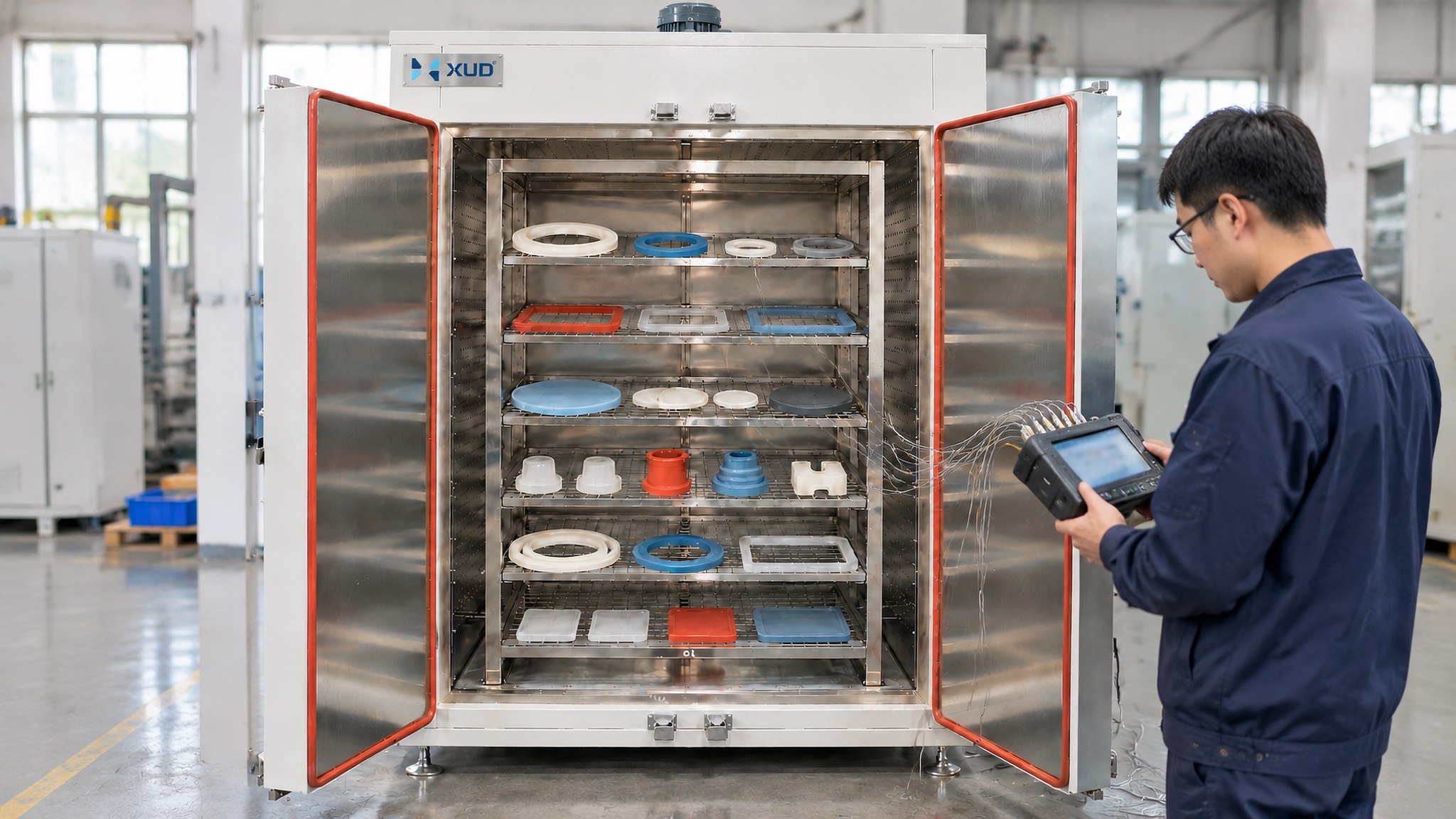
In rubber manufacturing, an oven may reach its target temperature while products located at different positions still experience different heating conditions. Parts near an airflow outlet, products placed in dense stacks, and thicker components may respond differently during the same heating cycle.
When production results vary, increasing the temperature setting is not always the correct solution. The real cause may be related to airflow distribution, loading arrangement, product thickness, heating time or the way temperature is measured.
This article explains how to evaluate these factors and identify practical ways to improve heating consistency inside an industrial rubber curing oven.
ARTICLE CONTENTS
Why the Set Temperature Is Not the Whole Story
The oven controller measures temperature at a specific sensor location. When the sensor reaches the target value, the control system responds according to its programmed logic. However, the sensor cannot automatically represent every location inside the chamber or the internal temperature of each rubber component.
There are several different temperatures to consider during production:
The temperature measured by the control sensor and used for regulation.
The temperature of the circulating air at different locations inside the oven.
The temperature reached by the rubber component itself, which may respond more slowly than the surrounding air.
These temperatures are related, but they are not necessarily identical. A chamber may stabilize quickly while a thick rubber part continues absorbing heat. For applications where the product temperature matters, monitoring the chamber alone may not provide sufficient process information.
Production insight: Reaching the set temperature is a control-system milestone. It is not automatically proof that every product has experienced the required heating conditions.
What Causes Temperature Differences Inside an Oven?
Temperature variation is usually influenced by several interacting factors rather than a single equipment component. Understanding these factors makes troubleshooting more effective.
Airflow Distribution
Uneven supply airflow, poorly positioned return-air openings or restricted circulation can create different heating conditions across the chamber.
Chamber Geometry
Large chambers, corners, loading zones and structural obstructions may influence air movement and temperature recovery.
Heating System Layout
The arrangement of heating elements, heat exchangers and circulation components affects how heat is introduced and distributed.
Door Opening and Heat Loss
Frequent door opening, poor sealing or insufficient insulation may cause temperature recovery differences, especially during busy production.
These factors should be considered together. Changing the fan arrangement without reviewing product loading, for example, may not solve the original problem.
Product Thickness and Heating Response
Two rubber components exposed to the same chamber temperature may not heat at the same rate. Product thickness, shape, mass, material properties and contact conditions influence how heat moves into the component.
A thin rubber seal may respond relatively quickly to its surrounding environment. A thick molded component may require more time for heat to penetrate toward its inner regions. If both products are processed using the same cycle without considering these differences, the heating result may not be comparable.
THREE PRODUCT FACTORS TO REVIEW
Thickness: Greater thickness may increase the time required for the internal product temperature to respond.
Shape: Complex geometry and contact between parts may affect heat exposure.
Batch arrangement: Closely packed products may experience different surrounding conditions from individually spaced parts.
For process-sensitive products, representative parts should be used when evaluating the heating cycle. Where necessary, product-level measurements can help determine whether the heating duration is sufficient.
The objective is not to apply the longest heating cycle to every product. It is to establish a heating condition that matches the product and the process requirements.
Air Circulation and Chamber Design
Forced hot air circulation is commonly used in industrial ovens to move heat throughout the chamber. A circulation fan, air supply path and return-air structure work together to create a heating environment around the products.
However, a fan alone does not guarantee uniform heating. The air must be able to move through the chamber and around the loaded products without excessive obstruction.
Fan capacity, duct arrangement, supply-air openings, return-air paths, chamber dimensions and loaded rack structure should be evaluated as a connected design.
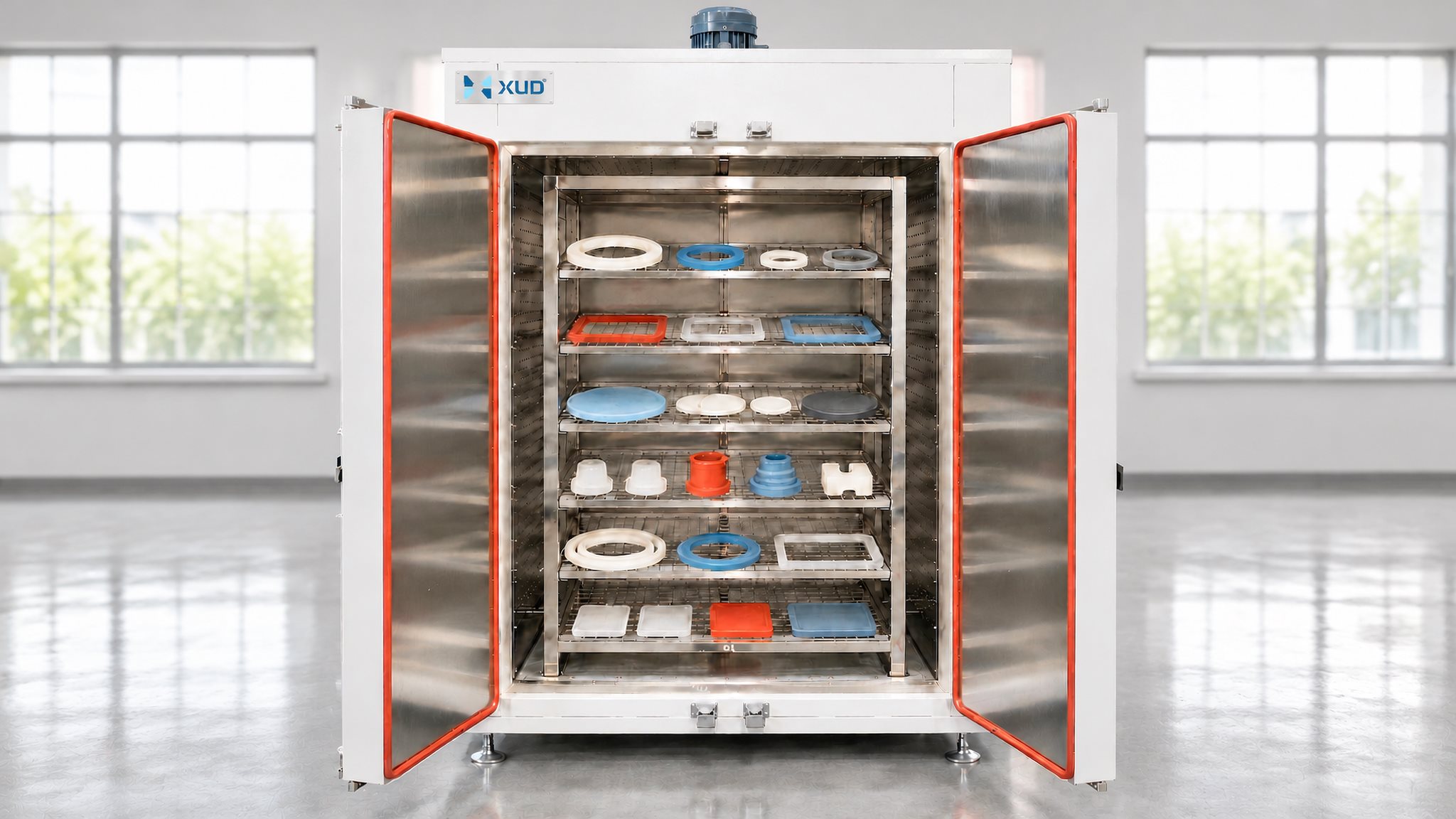
In a customized oven, the circulation arrangement should be considered alongside the actual product dimensions and loading structure. This is especially important for large chambers, multi-layer racks or trolley-loaded batches.
When heating differences occur, checking the air circulation path and product arrangement together can provide a more useful diagnosis than simply increasing fan speed or heating power.
Loading Density Can Change Heating Performance
An oven may perform differently when empty, partially loaded or fully loaded. Products and trays occupy space that would otherwise be available for circulating air. A loading pattern can therefore change the airflow paths and thermal response inside the chamber.
Increasing batch quantity is a common production goal, but excessive stacking or insufficient spacing may reduce the effectiveness of circulation around the products.
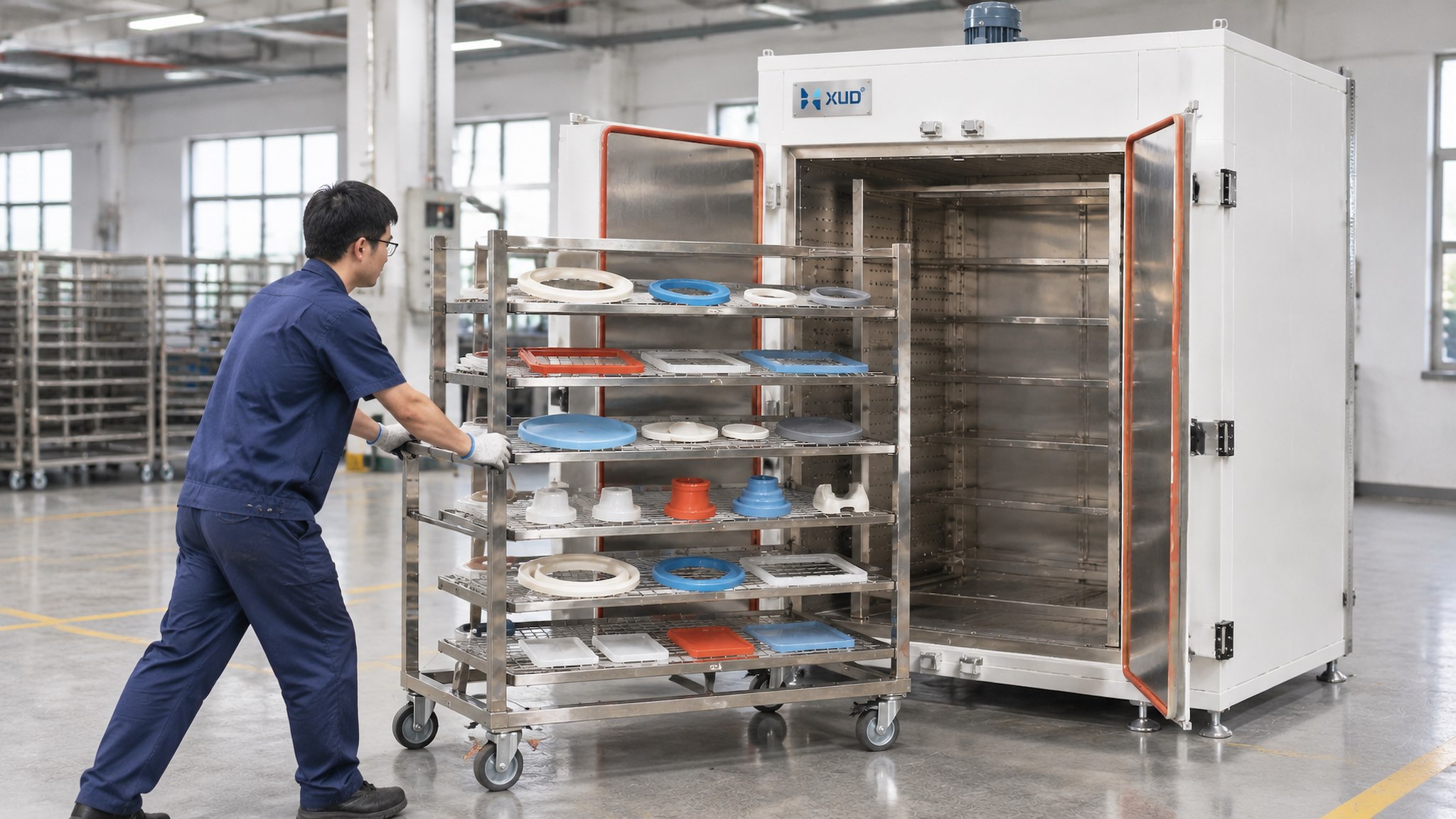
Before Increasing Batch Quantity
- Review the spacing between individual products.
- Check clearance between trays and rack levels.
- Keep circulation openings and return-air paths unobstructed.
- Avoid unnecessary stacking or product-to-product contact.
- Confirm that the loading pattern can be repeated by operators.
A practical production test should compare heating results under the actual intended loading arrangement. An empty chamber test may provide useful information about equipment behavior, but it cannot fully represent the conditions of a production batch.
For more detailed loading guidance, see our related article:
How to Load Rubber Parts in a Curing Oven Without Blocking Airflow →
How to Evaluate Temperature Uniformity in Practice
When temperature consistency is important, evaluation should be carried out under defined conditions. The test method depends on the product, the process and the level of control required.
A practical evaluation may include the following steps:
Specify the target temperature, loading quantity, rack arrangement and heating cycle.
Consider chamber areas that may experience different circulation conditions, rather than relying on a single measurement point.
Use suitable calibrated instruments and an agreed measurement method when temperature mapping or verification is required.
Evaluate the oven using the actual or representative batch arrangement.
Compare measurements with the process acceptance criteria established for the rubber application.
There is no single temperature uniformity tolerance that is suitable for every rubber product and oven application. The required range should be agreed according to the process and product quality requirements.
What to Check When Rubber Products Heat Unevenly
If the heating result varies from batch to batch, review the complete production setup before changing the temperature setting.
| Observed Problem | Possible Check |
|---|---|
| Different results between rack levels | Tray spacing, supply and return airflow, loading density |
| Thick parts heat more slowly | Product thickness, internal temperature response, cycle duration |
| Results change when batch quantity increases | Loading density, circulation clearance and batch arrangement |
| Temperature drops after loading | Product starting temperature, batch mass, heating capacity and recovery time |
| Different results across production days | Cycle settings, loading positions, door opening and operating routine |
Systematic checks help distinguish equipment-related issues from changes in the product, batch or operating method. This makes corrective action more targeted and helps establish a repeatable production routine.
Need a Rubber Curing Oven for Your Production?
Share your rubber product dimensions, batch quantity, required temperature, heating time and loading method. We can evaluate a suitable chamber size, heating system, circulation structure and loading configuration for your application.
WhatsApp: +86 18998007076
Email: annalan@xudoven.com
How to Choose an Industrial Rubber Curing Oven for Rubber Components
Related Article