How to Choose a Curing Oven for Carbon Fiber Composite Panels
XINYUANDA KNOWLEDGE CENTER
How to Choose a Curing Oven for Carbon Fiber Composite Panels
CARBON FIBER CURING GUIDE
PART 06 / 06
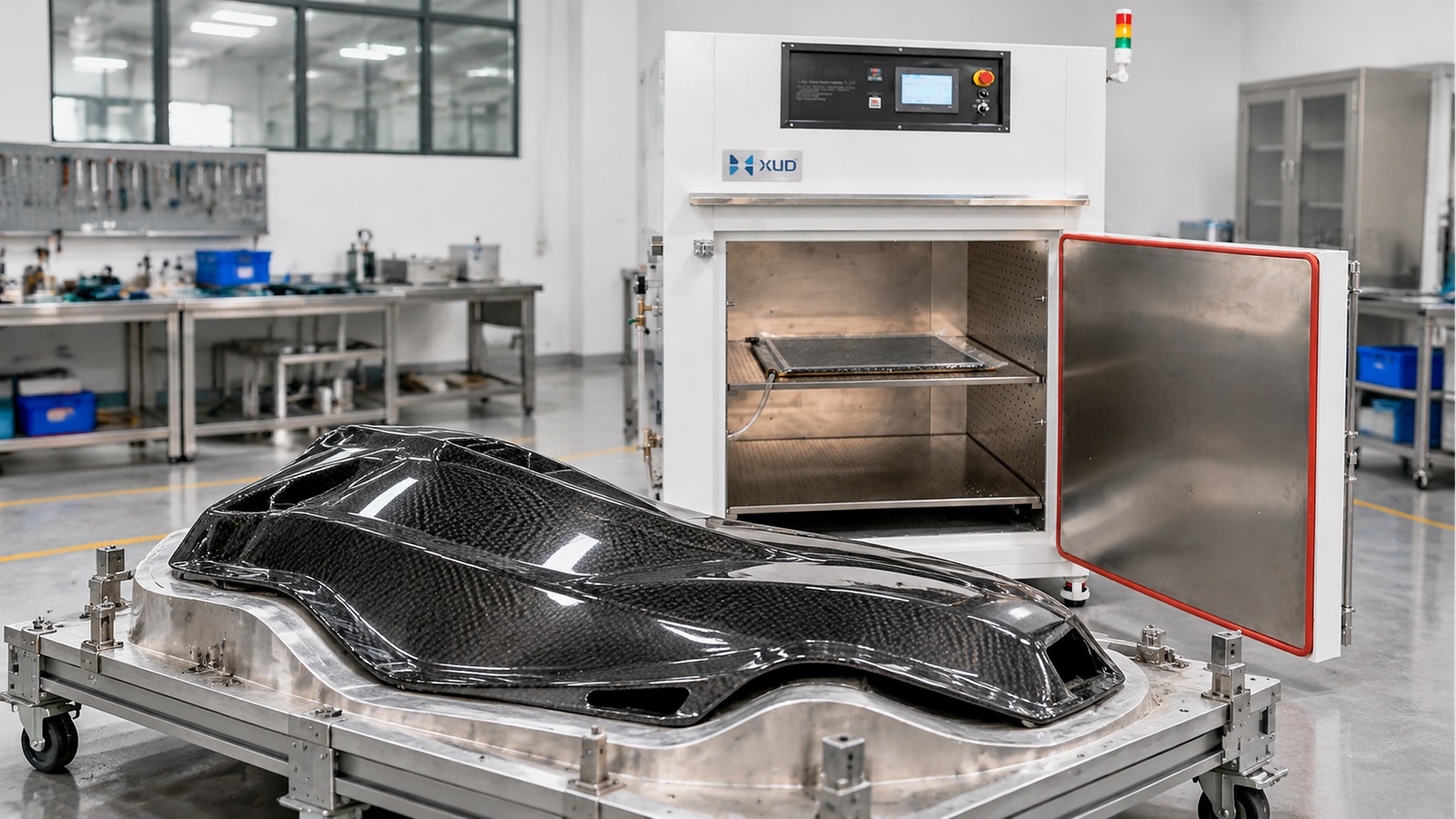
Choosing a curing oven for carbon fiber composite panels is not simply a matter of finding a chamber large enough to hold the panels. The oven must accommodate the complete production setup, including the composite material, tooling, vacuum bagging arrangement, support fixtures and loading method.
For manufacturers producing carbon fiber sheets, flat composite panels and molded components, the most effective oven selection process starts with the actual curing process rather than the equipment dimensions alone.
This guide explains the key factors to evaluate before purchasing a carbon fiber curing oven, helping production teams avoid common sizing mistakes and select equipment that fits their manufacturing requirements.
Table of Contents
- Start with the Complete Curing Setup, Not Just the Panel
- Determine the Required Oven Chamber Size
- Match the Temperature Range to the Material
- Evaluate Air Circulation and Temperature Distribution
- Choose a Suitable Loading and Support Method
- Consider Vacuum Bagging Requirements
- Size the Oven According to Production Capacity
- Information to Prepare Before Requesting an Oven Quote
- Frequently Asked Questions
- Final Selection Recommendations
1. Start with the Complete Curing Setup, Not Just the Panel
The first step is to define exactly what will enter the oven during production. The carbon fiber panel itself is only one part of the curing assembly.
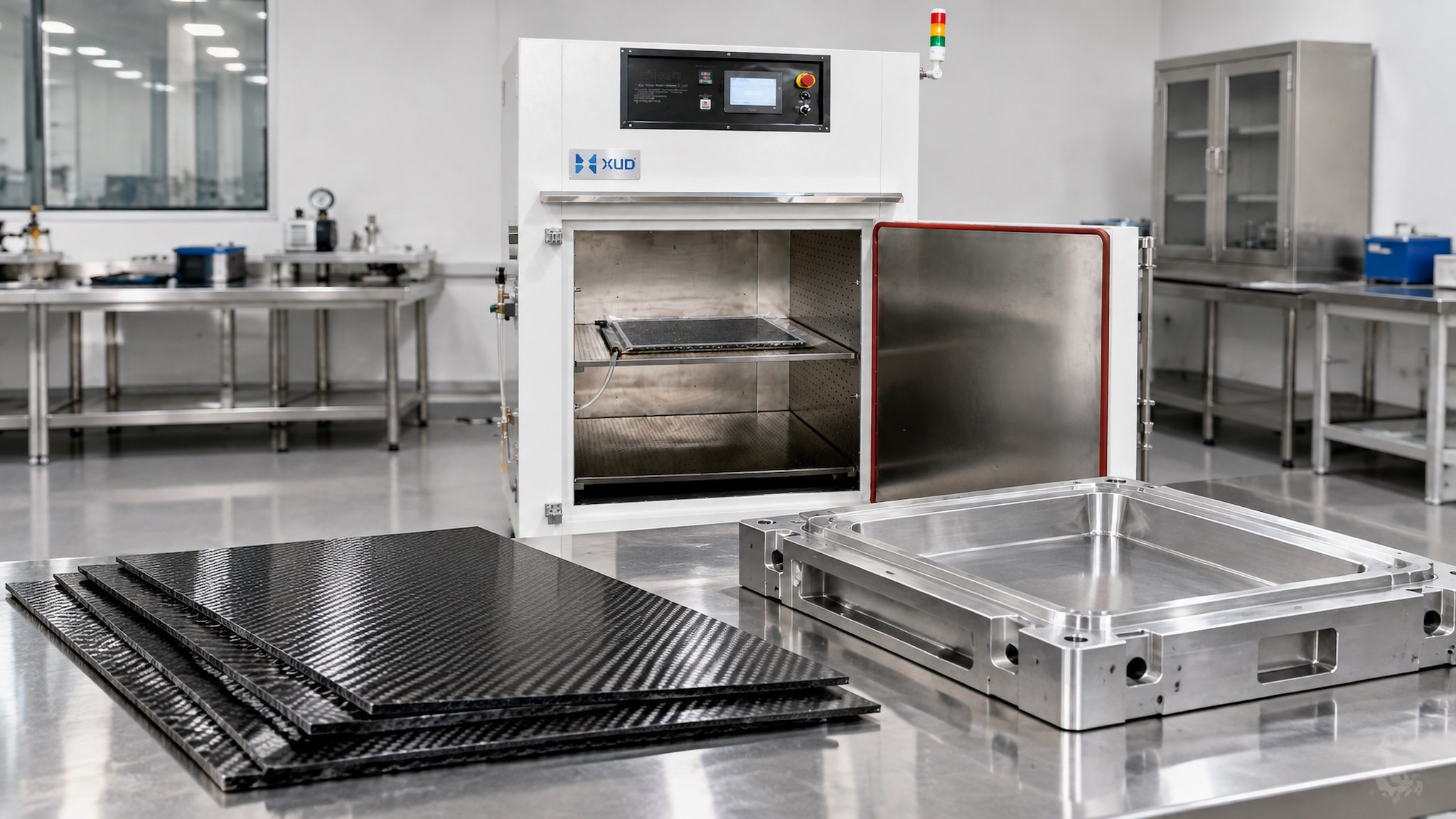
Depending on the manufacturing process, the complete setup may include:
- Carbon fiber prepreg or other approved composite materials
- Metal, composite or other compatible curing molds
- Vacuum bagging films and sealing materials
- Breather and release materials
- Support frames or positioning fixtures
- Vacuum hoses and connection arrangements
These additional components can significantly increase the required chamber space. A panel measuring 1,000 mm × 600 mm, for example, may require a larger loading area once the mold, bagging materials and supporting fixtures are included.
Measure the complete assembly in its actual loading condition. Do not calculate oven dimensions using the bare panel dimensions alone.
It is also important to understand whether the panel is cured flat, on a curved mold or in a more complex fixture. The shape and orientation of the tooling can change the required chamber height and loading clearance.
2. Determine the Required Oven Chamber Size
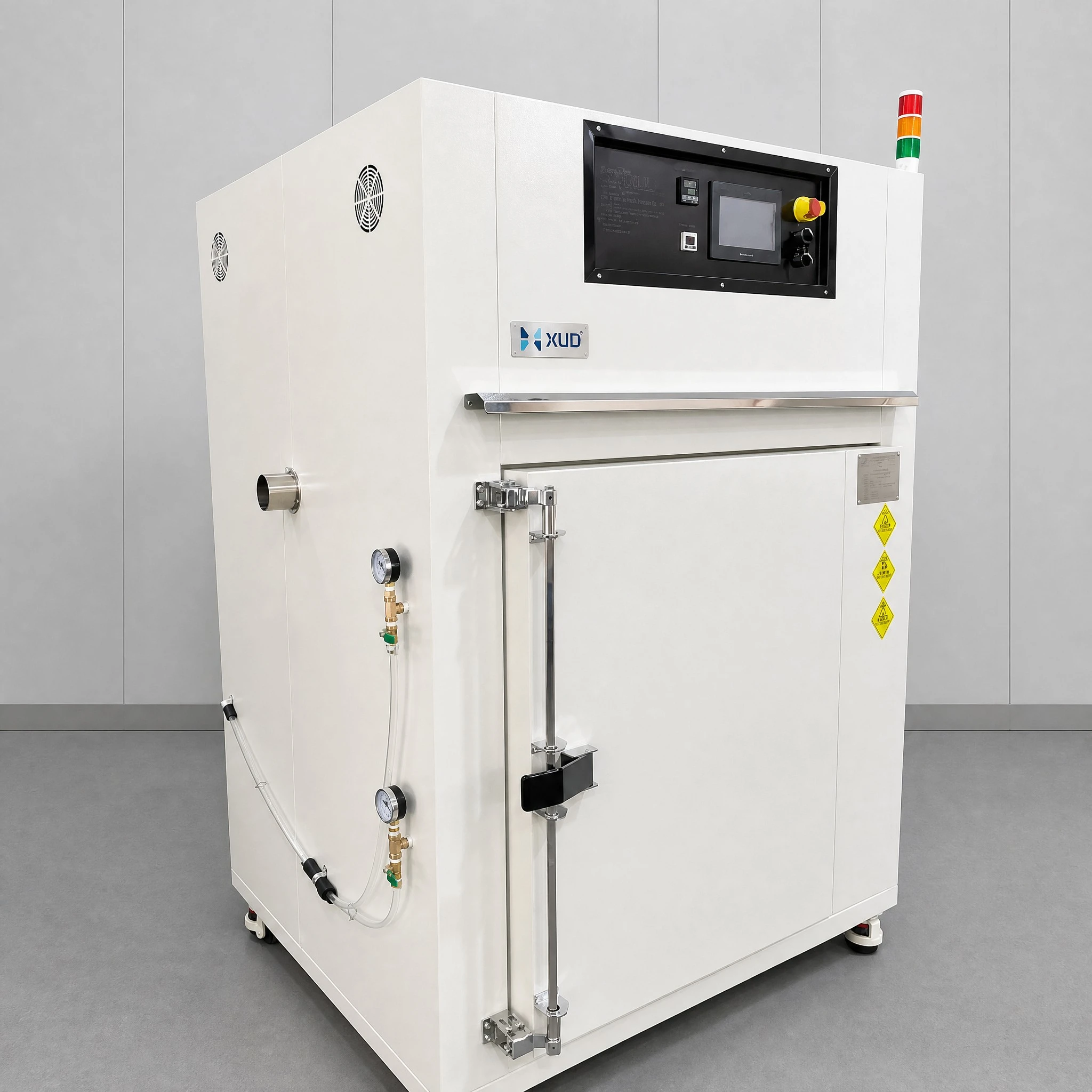
Chamber sizing should account for three dimensions: usable width, usable depth and usable height. The external dimensions of an oven do not represent the actual space available for curing.
Width and depth
For flat carbon fiber panels, the usable width and depth must accommodate the panel, mold and any surrounding fixtures. Additional clearance is needed for loading, unloading and the circulation of heated air.
Chamber height
Height is often overlooked when selecting an oven for composite panels. A relatively thin panel may require a much taller loading space if it is mounted on a thick mold, a support frame or a multi-level rack.
Usable loading space
Ask the manufacturer to confirm the usable internal dimensions and explain how the heating air circulates around the proposed loading arrangement. The loading area should not be confused with the total internal chamber volume.
| Dimension | What to Check |
|---|---|
| Width | Panel width, mold size and side clearance |
| Depth | Panel length, loading direction and rear clearance |
| Height | Mold thickness, support fixtures and rack arrangement |
| Loading clearance | Space for handling and unobstructed airflow |
For large panels, it is useful to provide the oven manufacturer with a drawing or photograph of the panel and mold. This makes it easier to evaluate chamber dimensions and loading feasibility before equipment production.
3. Match the Temperature Range to the Material
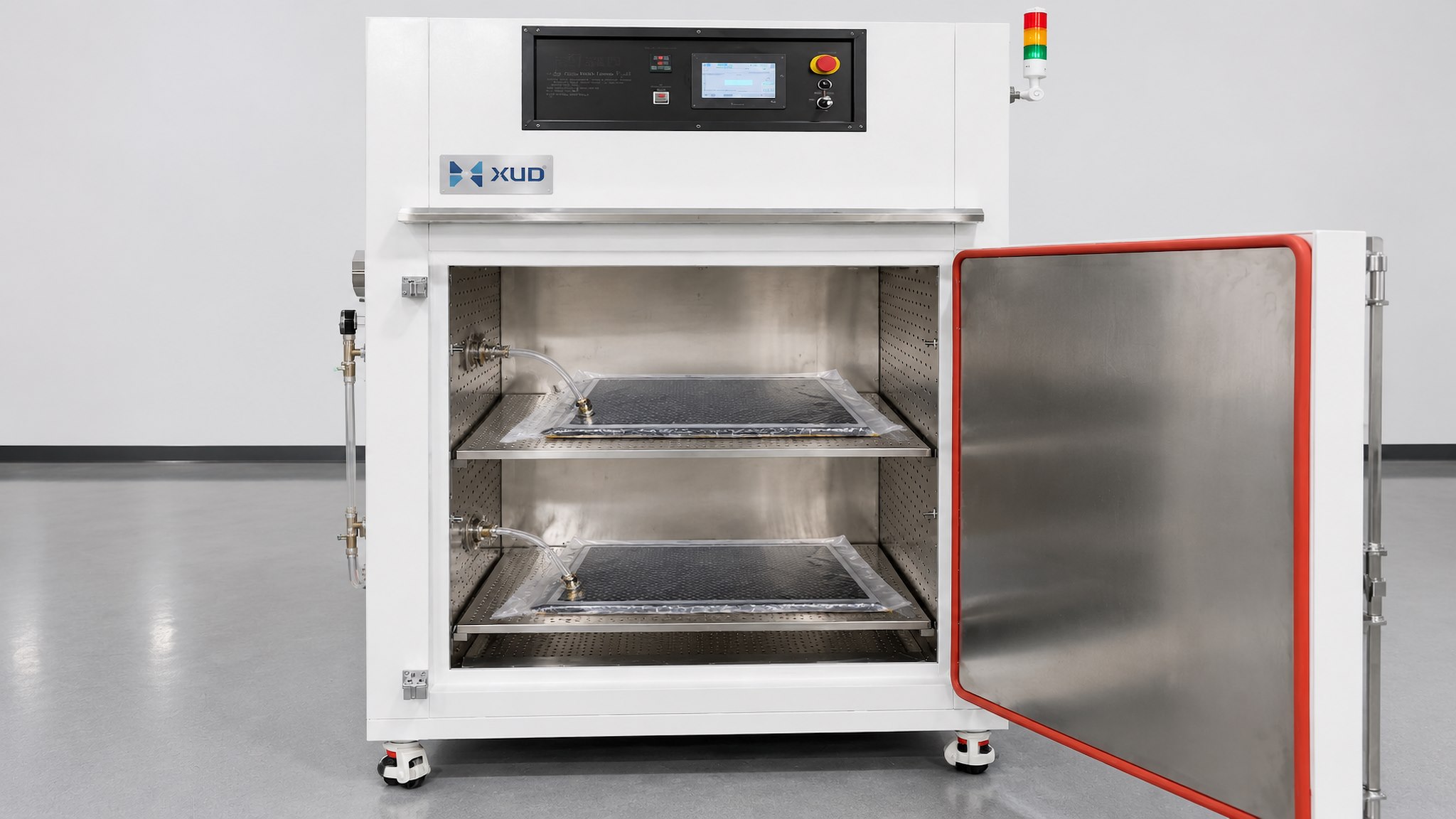
Carbon fiber composite materials do not all use the same curing temperature. The required temperature depends on the resin system, prepreg specification and approved manufacturing process.
Before selecting an oven, obtain the relevant technical data sheet and curing instructions from the material supplier. Pay particular attention to:
- Specified curing temperature
- Permitted heating rate or temperature ramp
- Required holding time
- Temperature measurement and monitoring requirements
- Cooling procedure and any restrictions on demolding
- Vacuum requirements, where applicable
The oven's maximum operating temperature should provide a suitable operating range for the selected material and process. However, a higher maximum temperature does not automatically mean that an oven is better for a particular composite application.
Do not use a generic curing temperature or holding time simply because it is common in composite manufacturing. Follow the material supplier's approved curing cycle. The oven must be configured to meet the actual process requirements.
For manufacturers using different resin systems, it may be necessary to evaluate the full range of production temperatures rather than choosing equipment based on only one product.
4. Evaluate Air Circulation and Temperature Distribution
For an industrial composite curing oven, the heating system and internal air circulation arrangement deserve careful attention.
Hot air circulation helps distribute heat throughout the chamber. However, the presence of a circulation fan alone does not guarantee that every part of a loaded panel will experience the same temperature.
Temperature distribution can be affected by several factors:
- Panel size and thickness
- Mold material and thermal mass
- Distance between the workpiece and chamber walls
- Position of shelves, racks and support fixtures
- Air supply and return locations
- Loading density and arrangement
For example, placing a large mold directly in front of an air outlet may obstruct the airflow path. Similarly, loading multiple panels too close together can change the way heated air moves through the chamber.
When evaluating an oven, ask the manufacturer how the circulation system is arranged and whether temperature distribution can be evaluated under representative loading conditions.
The chamber air temperature and the actual temperature of a composite panel are not necessarily the same at every moment. Thick molds and large workpieces may heat up more slowly than the surrounding air. For critical processes, product-temperature monitoring and validation should follow the material supplier's and customer's process requirements.
5. Choose a Suitable Loading and Support Method
Different composite manufacturers may need different loading solutions depending on panel dimensions, mold weight, production volume and workshop layout.
Fixed shelves or support racks
Fixed shelves can be suitable for smaller panels or production setups with consistent workpiece dimensions. The shelf spacing should allow sufficient clearance for the molds and airflow.
Removable trays
Removable trays can make it easier to prepare panels outside the oven and transfer them into the chamber. Their dimensions and load capacity should be matched to the actual tooling and workpiece weight.
Trolley loading
For heavier molds or larger composite assemblies, a trolley-based loading arrangement may reduce manual handling. The trolley structure, wheel arrangement and chamber floor must be designed for the intended load and operating temperature.
One important point is that maximizing the number of panels per batch is not always the best solution. If panels are positioned too closely together, the arrangement may obstruct airflow or make loading difficult.
When planning a multi-level arrangement, consider the distance between each level, the size of the molds and the accessibility required by operators.
6. Consider Vacuum Bagging Requirements
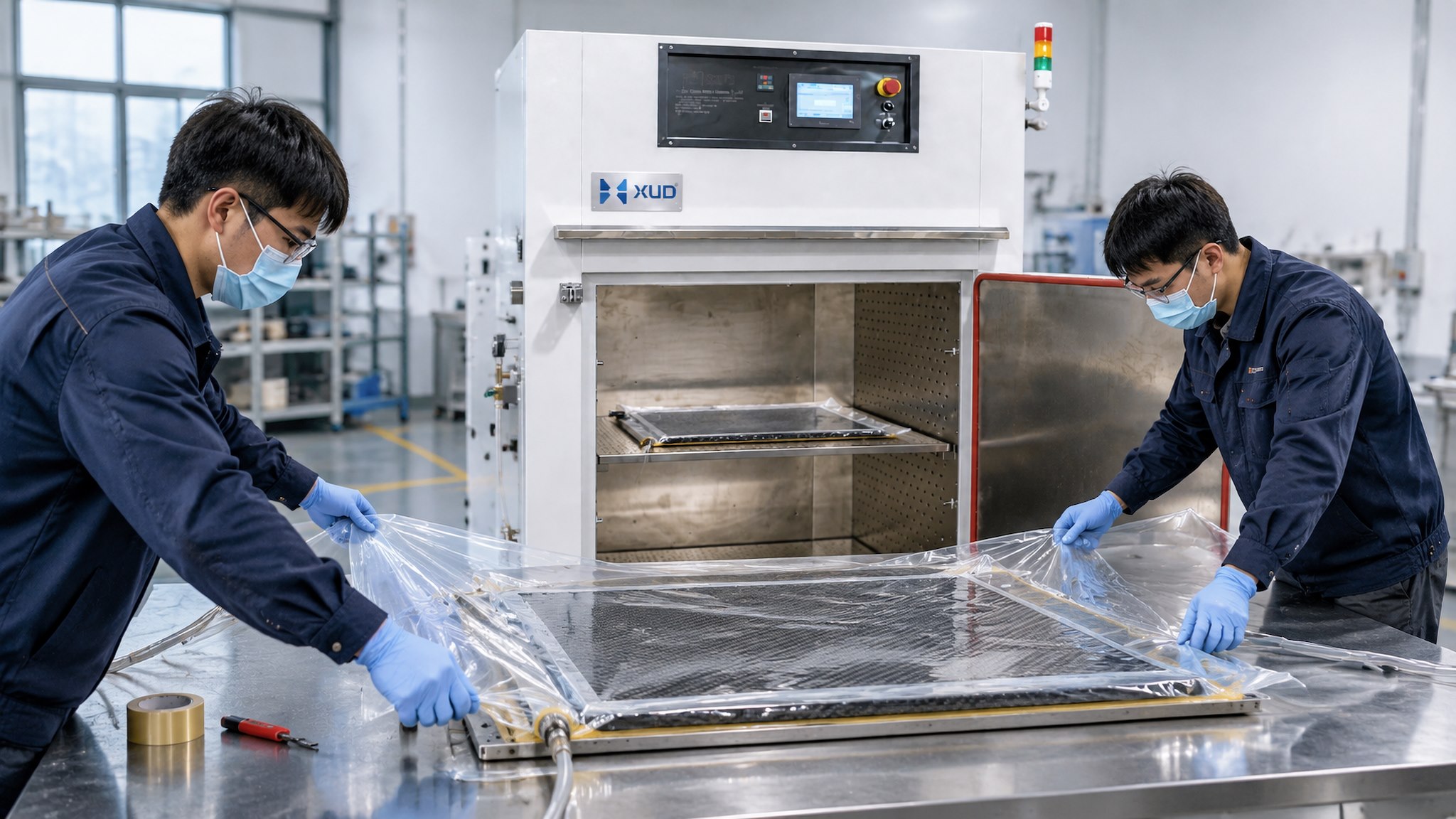
Many carbon fiber composite panel processes use vacuum bagging to consolidate the material during curing. If the selected material and process require vacuum, the oven must accommodate the vacuum connection arrangement.
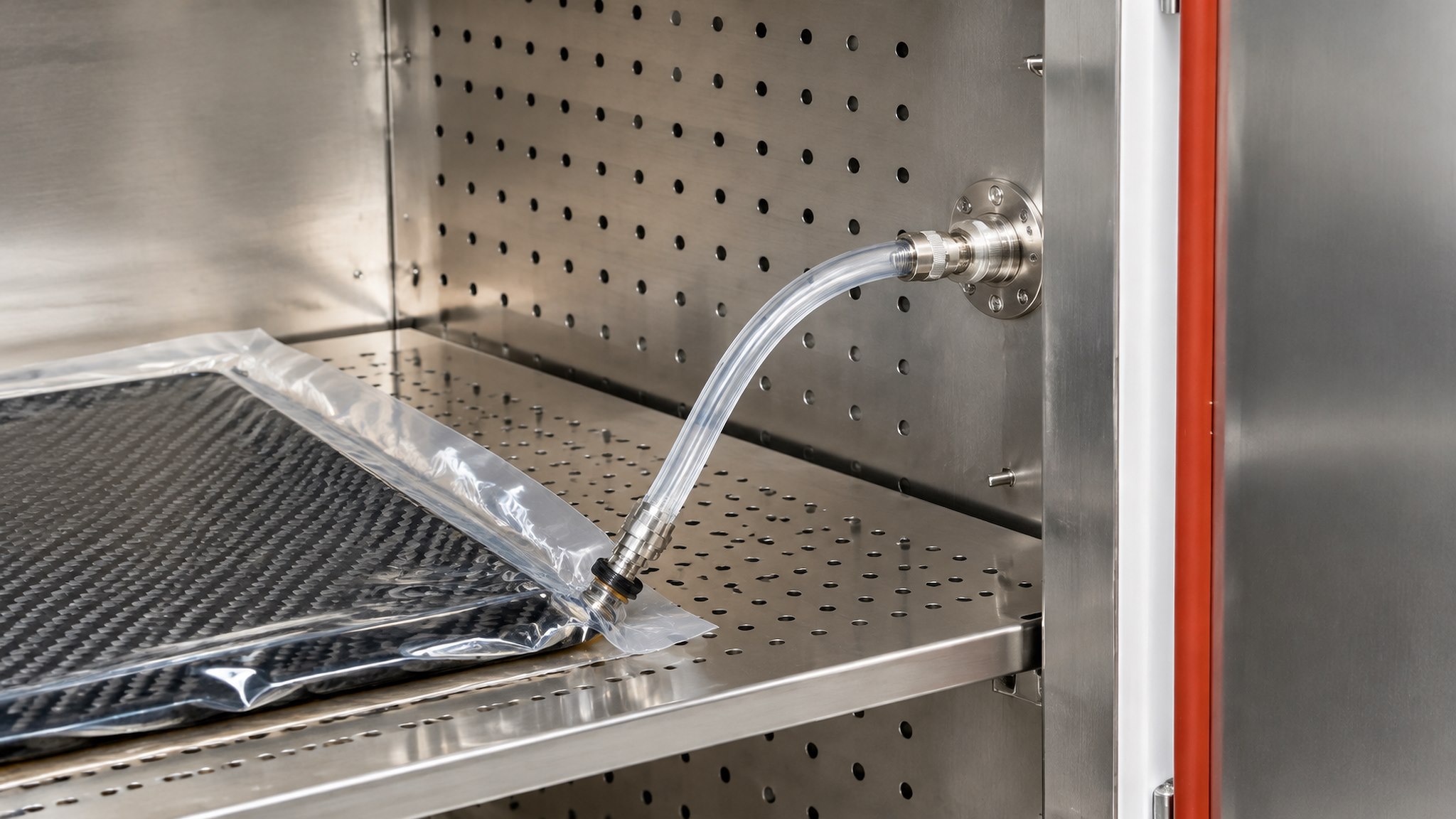
In a typical oven-based vacuum bagging setup, the composite layup is sealed inside a vacuum bag. A hose connects the bagging assembly to an external vacuum pump. Air is removed from inside the bag, creating a pressure difference that helps compact the laminate.
When selecting an oven, consider the following:
- Whether vacuum connections are required inside the chamber
- How vacuum hoses will pass through the oven wall
- Whether the connection location is convenient for the intended mold arrangement
- Whether hoses and sealing materials are suitable for the operating temperature
- Whether the external vacuum pump is supplied separately or included in the equipment quotation
A standard industrial curing oven provides controlled heating and, when configured, vacuum connections for an external vacuum system. It does not automatically provide the positive pressure environment of an autoclave. Confirm that the material supplier approves the intended oven and vacuum bagging process before production.
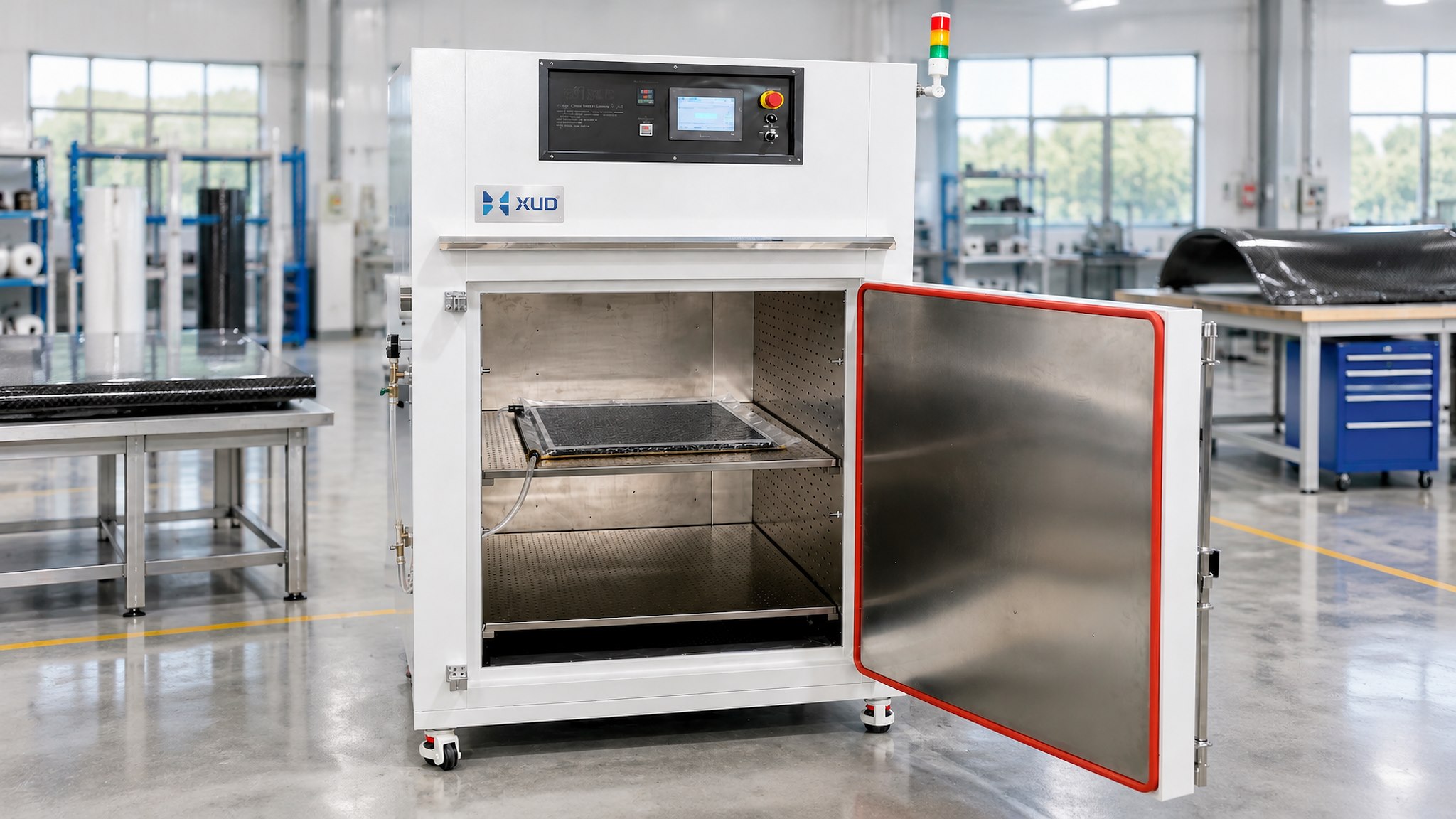
Our carbon fiber curing oven can be configured with vacuum connection ports inside the chamber. The vacuum pump is an external unit and should be specified separately unless it is explicitly included in the quotation.
For a more detailed explanation of the process, see our guide to vacuum bagging carbon fiber composite panels.
7. Size the Oven According to Production Capacity
Production capacity is another important factor. An oven designed for occasional prototype work may not be suitable for a factory producing composite panels every day.
Before choosing the chamber size, estimate the number of panels that need to be processed in each batch and how frequently the oven will operate.
Single-piece or prototype production
For research, development and low-volume production, a smaller chamber may be sufficient. Flexibility and convenient loading may be more important than maximizing the number of panels per batch.
Small-batch production
For regular production of several panels per batch, consider the required loading area, rack arrangement and the time needed for loading and unloading. The chamber should support repeatable positioning without overcrowding.
Larger-scale production
For higher production volumes, a larger chamber or a customized loading system may be worth evaluating. However, increasing the chamber size also changes the heating load, air circulation requirements and overall equipment configuration.
A realistic capacity estimate should include loading time, heating, curing hold time, cooling, unloading and preparation for the next batch. The curing cycle specified by the material supplier must remain the basis of production planning.
8. Information to Prepare Before Requesting an Oven Quote
9. Frequently Asked Questions
Q1: What size curing oven do I need for carbon fiber panels?
The required size depends on the panel dimensions, mold size, support fixtures and loading arrangement. Measure the complete curing assembly and allow sufficient clearance for handling and airflow before determining the usable chamber dimensions.
Q2: What temperature should a carbon fiber curing oven reach?
There is no single curing temperature for all carbon fiber materials. The required temperature depends on the resin system and material specification. Select an oven based on the approved curing cycle supplied by the material manufacturer.
Q3: Is hot air circulation necessary for carbon fiber curing?
Hot air circulation is commonly used in industrial curing ovens to distribute heat throughout the chamber. However, actual temperature distribution depends on the oven design and loading conditions. For critical applications, evaluate the oven with a representative load.
Q4: Can a standard industrial oven be used with vacuum bagging?
An industrial oven can be configured with vacuum connection ports for an external vacuum system. Whether this process is suitable depends on the composite material and its approved curing procedure. Not every prepreg system is suitable for oven-only vacuum bag curing.
Q5: Does a carbon fiber curing oven include a vacuum pump?
Not necessarily. Some oven configurations provide vacuum connection ports while the vacuum pump is supplied separately. Always confirm whether the pump, hoses and related accessories are included in the equipment quotation.
Final Selection Recommendations
Selecting a curing oven for carbon fiber composite panels requires more than matching the chamber dimensions to the panel size. The material specification, complete tooling arrangement, heating requirements, airflow, vacuum connections and production capacity must all be considered together.
For the best result, define the actual curing process first, then use that information to determine the oven configuration. This approach helps avoid unnecessary equipment capacity, insufficient loading space and process limitations after installation.
At Dongguan Xinyuanda Machinery Equipment Co., LTD., we manufacture customized industrial ovens for composite material applications. Our carbon fiber curing oven features electric heating, hot air circulation and internal vacuum connection ports, with a maximum working temperature of 250°C. The chamber dimensions and loading arrangement can be customized according to the customer's workpieces and production requirements.
CUSTOMIZED COMPOSITE CURING SOLUTIONS
Looking for a Carbon Fiber Curing Oven?
Share your panel dimensions, mold drawings, curing temperature and production requirements with our team. We can help evaluate a suitable oven size and configuration for your application.
View Carbon Fiber Curing OvenWhatsApp: +86 18998007076
Email: annalan@xudoven.com
CARBON FIBER CURING GUIDE
Explore the Complete Series
PART 01 — How to Cure Carbon Fiber Prepreg in an Industrial Oven
PART 02 — Vacuum Bagging Process for Carbon Fiber Composite Panels
PART 03 — Composite Curing Oven vs. Autoclave: Key Differences
PART 04 — What to Look for When Buying a Carbon Fiber Curing Oven
PART 05 — How to Cure Complex-Shaped Carbon Fiber Composite Parts
PART 06 — How to Choose a Curing Oven for Carbon Fiber Composite Panels (You are here)
How to Cure Complex-Shaped Carbon Fiber Composite Parts
Related Article