How to Dry PCB Assemblies After Cleaning Without Exposing Components to Excessive Heat
PCB DRYING PROCESS GUIDE
How to Dry PCB Assemblies After Cleaning Without Exposing Components to Excessive Heat
A practical guide to moisture removal, temperature management, airflow and drying equipment selection for electronics manufacturing.
Cleaning is an important step in PCB assembly manufacturing. After soldering or other production processes, cleaning may be required to remove flux residues, contaminants and other unwanted materials from circuit boards.
However, cleaning is only part of the process. Moisture or cleaning-agent residues left on a PCB assembly may affect subsequent manufacturing operations and product reliability. Connectors, component gaps, through-holes and areas beneath components can be particularly difficult to dry completely.
At the same time, applying excessive heat can create another problem. Different electronic components and PCB materials have different temperature limitations. A drying process that is too aggressive may expose sensitive components to unnecessary thermal stress.
So, how can manufacturers dry PCB assemblies effectively after cleaning without exposing components to uncontrolled heat?
This guide explains the key factors involved in PCB assembly drying, including moisture retention, temperature selection, airflow, equipment configuration and process verification.
In This Article
1. Why PCB Assemblies Need Proper Drying After Cleaning
After a cleaning operation, liquid may remain on the PCB surface or become trapped in areas that are difficult to access. If the assembly moves directly to the next production stage without sufficient drying, residual moisture may interfere with subsequent processing.
Potential problems include:
- Residual moisture: Liquid trapped around components, connectors or solder joints may remain after surface drying.
- Contamination concerns: Remaining cleaning-agent residues may affect the cleanliness requirements of the assembly.
- Process inconsistency: Different drying conditions between batches can lead to inconsistent results.
- Thermal stress: Excessive temperatures or unsuitable heating conditions may affect temperature-sensitive components.
For this reason, PCB drying should be treated as a controlled manufacturing process rather than simply exposing circuit boards to hot air.

2. Where Moisture Can Remain on a PCB Assembly
One of the challenges in PCB assembly drying is that visible surface moisture does not always represent the total amount of liquid remaining on the board.
Manufacturers should pay particular attention to the following areas:
Under and Around Electronic Components
Small gaps beneath components can retain liquid and may require sufficient exposure to suitable airflow.
Connectors and Through-Holes
Connectors, plated through-holes and narrow openings may retain moisture that is not immediately visible.
Overlapping or Densely Arranged Assemblies
When boards are placed too close together, airflow access may be restricted, making drying less consistent between positions.
Understanding where moisture is likely to remain helps manufacturers determine the appropriate loading arrangement, airflow conditions and drying procedure.
3. How to Control Temperature During PCB Drying
Temperature selection is one of the most important considerations when drying PCB assemblies. The objective is not to use the highest possible temperature, but to establish suitable conditions for removing moisture while respecting the thermal limitations of the assembly.
Before setting a drying temperature, manufacturers should consider:
- PCB substrate: Different board materials may have different thermal characteristics.
- Electronic components: Components, connectors and other assembled parts may have different allowable temperature limits.
- Cleaning medium: Water-based cleaning agents and solvent-based cleaning agents require different process and safety assessments.
- Drying objective: The required level of dryness should be defined according to the next manufacturing process and product requirements.
- Exposure time: Temperature and drying duration should be evaluated together rather than independently.
Important: There is no universal drying temperature or duration suitable for every PCB assembly. The actual process parameters should be determined through material specifications, component limitations and process validation.
For production applications, a programmable temperature control system can help operators set and repeat the selected heating conditions. However, the actual temperature experienced by the PCB should still be verified under representative loading conditions.
4. Why Air Circulation Matters in PCB Drying
Temperature control alone does not guarantee consistent drying. Air circulation also affects how heat reaches different positions inside the drying chamber.
In a forced hot air circulation system, heated air is moved through the chamber instead of relying only on natural convection. This helps distribute heat and supports more consistent exposure across the loaded products when the airflow path and loading arrangement are properly designed.
Several factors should be considered:
- Tray spacing: Adequate space between trays helps prevent airflow obstruction.
- Loading quantity: Excessive loading may restrict airflow and affect the drying process.
- Board orientation: The arrangement of PCB assemblies should allow air to reach relevant surfaces.
- Airflow distribution: The chamber design should be evaluated under actual production loading conditions.
It is also important to distinguish between air circulation and moisture removal. Forced circulation moves heated air through the chamber, while exhaust helps release some air from the chamber. These functions do not automatically provide active dehumidification or precise humidity control.
For applications with specific moisture-removal requirements, the exhaust arrangement and overall drying process should be evaluated according to the cleaning medium and production conditions.
5. Choosing Suitable Drying Equipment for PCB Assemblies
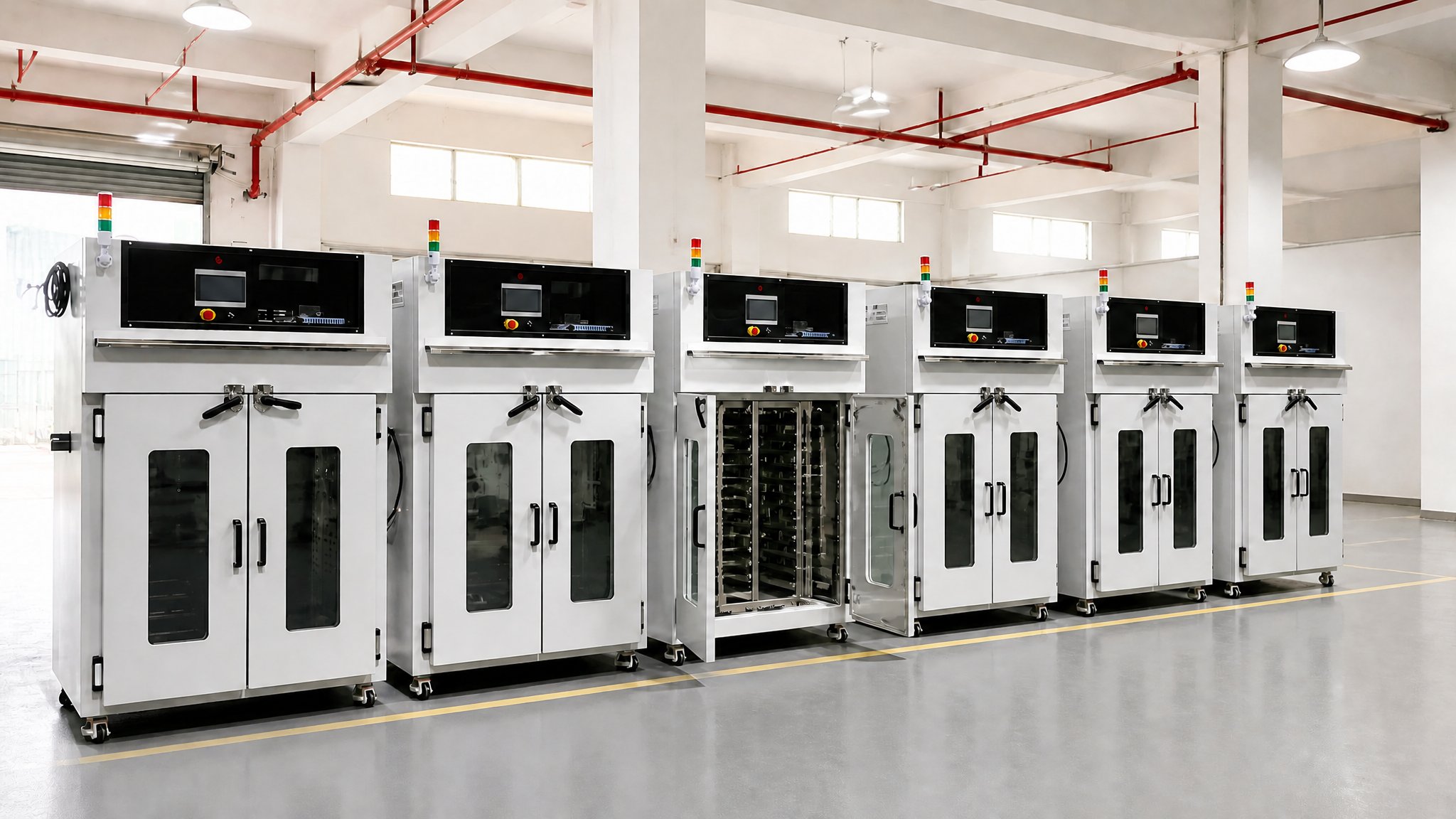
For manufacturers processing PCB assemblies in batches, an industrial drying oven may provide a more organized and repeatable heating environment than an uncontrolled manual drying arrangement.
When evaluating equipment, consider the following configuration points:
| Equipment Feature | Why It Matters |
|---|---|
| Temperature control | Allows operators to set process temperatures according to PCB and component requirements. |
| Forced hot air circulation | Helps distribute heated air throughout the chamber. |
| Multi-layer tray racks | Support organized batch loading and make better use of chamber space. |
| PLC and touchscreen control | Provide a convenient interface for setting and managing operating parameters. |
| Exhaust arrangement | Allows chamber air to be discharged according to the equipment design and process requirements. |
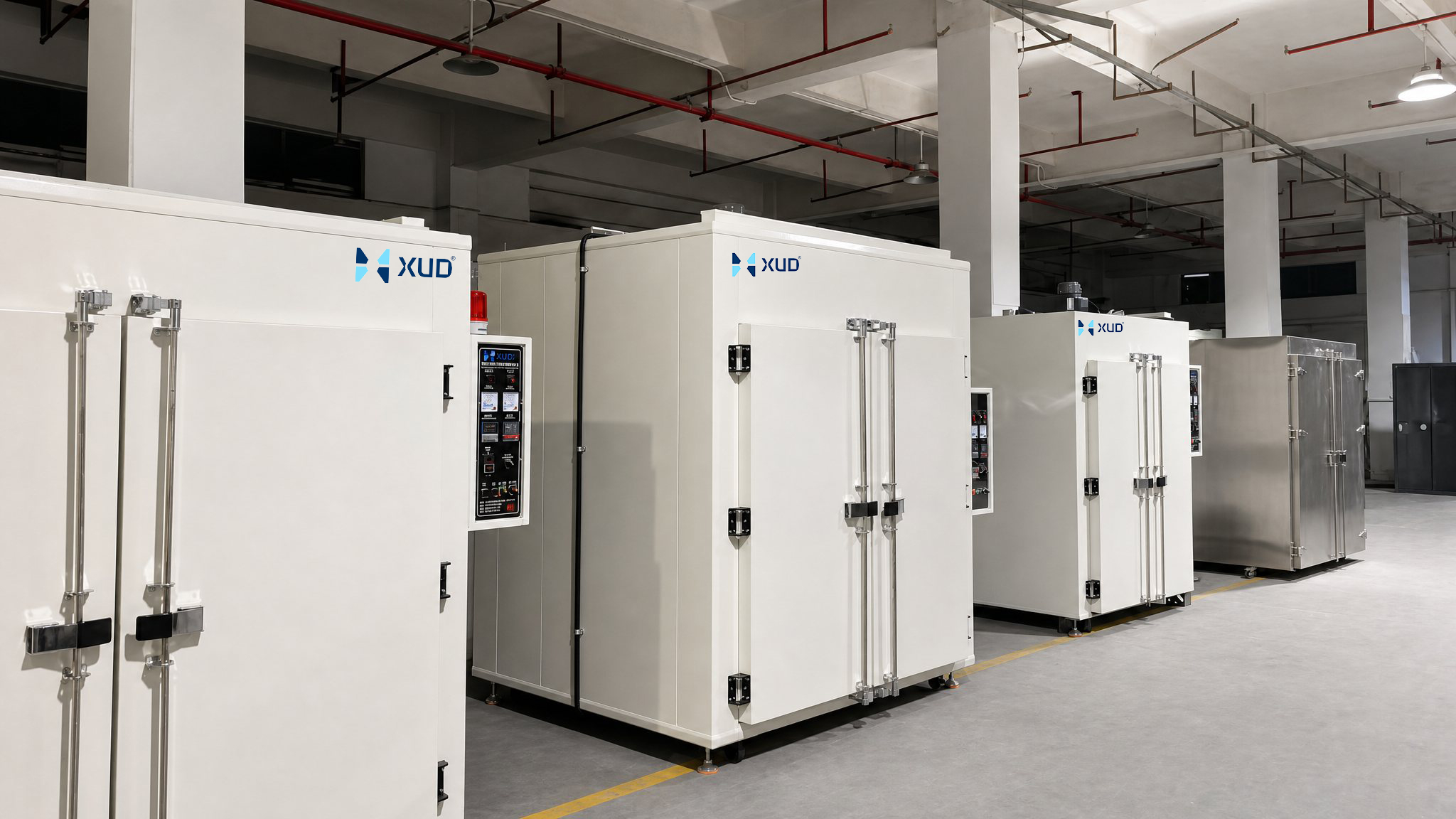
For example, Xinyuanda offers a customizable PCB drying oven featuring electric heating, forced hot air circulation, natural exhaust, touchscreen and PLC control, with a working temperature range from ambient temperature to 250°C.
The equipment also features double doors and multi-layer tray racks for batch processing. Its configuration can be discussed according to the PCB dimensions, loading quantity and production requirements.
Explore Our Custom PCB Drying Oven
Looking for a batch drying solution for PCB assemblies and electronic components? View the equipment details and available customization options.
View PCB Drying OvenSafety consideration: If the cleaning process uses flammable or volatile solvents, do not assume that a standard hot air drying oven is suitable. The solvent properties, vapor concentration, exhaust requirements and applicable safety measures must be assessed before selecting the equipment. Special ventilation or explosion-protection measures may be required.
6. How to Verify the PCB Drying Process
A drying process should be evaluated using actual production conditions rather than relying only on the temperature displayed by the controller.
Manufacturers can establish a practical verification procedure using the following steps:
- Define the acceptance criteria. Determine what level of dryness is required before the next production stage.
- Check the component limitations. Confirm the allowable temperature exposure for the PCB assembly.
- Use representative loading. Test the equipment with realistic tray spacing and batch quantities.
- Monitor relevant positions. Evaluate temperature conditions at different chamber locations and product positions.
- Inspect the results. Check representative PCB assemblies for residual moisture or other process-related issues.
- Record validated settings. Document the approved temperature, duration, loading arrangement and inspection results.
Once the process has been validated, operators can follow the documented procedure to improve batch-to-batch consistency.
7. Common PCB Drying Mistakes to Avoid
Even with suitable equipment, improper operation can affect drying results. The following mistakes should be avoided:
- Using excessive temperatures: Higher temperatures do not necessarily mean better drying and may expose components to unnecessary thermal stress.
- Loading too many boards: Overloading can restrict airflow and make drying conditions less consistent.
- Ignoring hidden moisture: A dry-looking PCB surface does not always mean that gaps and openings are completely dry.
- Skipping process verification: Using unverified settings may lead to inconsistent results between batches.
- Ignoring cleaning-agent safety: Solvent-based cleaning processes require specific evaluation before hot air drying.
A well-planned drying procedure should balance temperature, airflow, loading arrangement and the characteristics of the PCB assembly.
8. Frequently Asked Questions About PCB Assembly Drying
Q1: What temperature should be used to dry PCB assemblies after cleaning?
There is no single temperature suitable for all PCB assemblies. The correct setting depends on the PCB substrate, electronic components, cleaning medium and process requirements. Always check component specifications and validate the drying conditions before production use.
Q2: Can forced hot air circulation improve PCB drying?
Forced hot air circulation helps move heated air through the drying chamber and can support more consistent heat distribution. Actual results depend on chamber design, airflow paths, tray spacing and product loading.
Q3: Can all PCB cleaning agents be dried in a standard industrial oven?
No. Water-based cleaning agents and solvent-based cleaning agents have different safety and process requirements. Flammable or volatile solvents require a specific assessment of vapor hazards, ventilation and equipment suitability before heating.
Q4: What should manufacturers consider when selecting a PCB drying oven?
Important factors include working temperature, temperature control, air circulation, exhaust arrangement, chamber capacity, tray configuration, loading quantity and compatibility with the cleaning medium.
Q5: Can a PCB drying oven be customized?
Yes. Industrial drying ovens can be customized according to PCB dimensions, batch capacity, chamber size, tray arrangement, heating requirements and control preferences. The actual configuration should be determined from the production process and safety requirements.
Conclusion: Make PCB Drying a Controlled Process
Drying PCB assemblies after cleaning requires more than simply applying heat. Manufacturers need to consider moisture retention, component temperature limitations, airflow distribution, loading arrangements and cleaning-agent safety.
A suitable industrial drying oven, combined with a validated operating procedure, can help manufacturers establish a more organized and repeatable batch drying process.
If you are looking for a customized drying solution for PCB assemblies or electronic components, Xinyuanda can discuss the equipment configuration according to your product dimensions and production requirements.
Looking for a Custom Industrial Drying Oven?
Tell us about your products, drying requirements and production capacity. Our team can help discuss a suitable equipment configuration.
WhatsApp: +86 189 9800 7076
Email: annalan@xudoven.com
Continuous Mesh Belt Oven for Heating and Drying Metal Fasteners
Related Article