Horizontal Airflow Oven vs. Vertical Airflow Oven
↑ Back to Table of Contents | ↑ Back to Top
In industrial production, it is not unusual for two ovens set to exactly the same temperature to deliver noticeably different drying or curing results when processing the same type of workpiece. One batch may meet the required uniformity, while another may contain areas that are not fully dry or parts with inconsistent curing.
When selecting equipment, buyers often focus on basic specifications such as maximum operating temperature and chamber volume, while overlooking a key factor: airflow direction. The path of the hot air and the way it contacts the workpieces directly affect heat transfer and temperature uniformity, which in turn influence product yield and production efficiency.
This article compares horizontal and vertical airflow ovens in terms of operating principles, suitable applications, and performance. The goal is to help you select an industrial drying oven that matches your actual process requirements.
Table of Contents
- 1. What Is a Horizontal Airflow Oven?
- 2. What Is a Vertical Airflow Oven?
- 3. Key Differences Between Horizontal and Vertical Airflow Ovens
- 4. How to Choose an Airflow Pattern for Your Workpieces
- 5. How to Verify Oven Airflow Performance Before Purchasing
- 6. Can Industrial Ovens Be Customized with Different Airflow Designs?
- Frequently Asked Questions (FAQ)
1. What Is a Horizontal Airflow Oven?
1.1 How Horizontal Hot Air Circulation Works
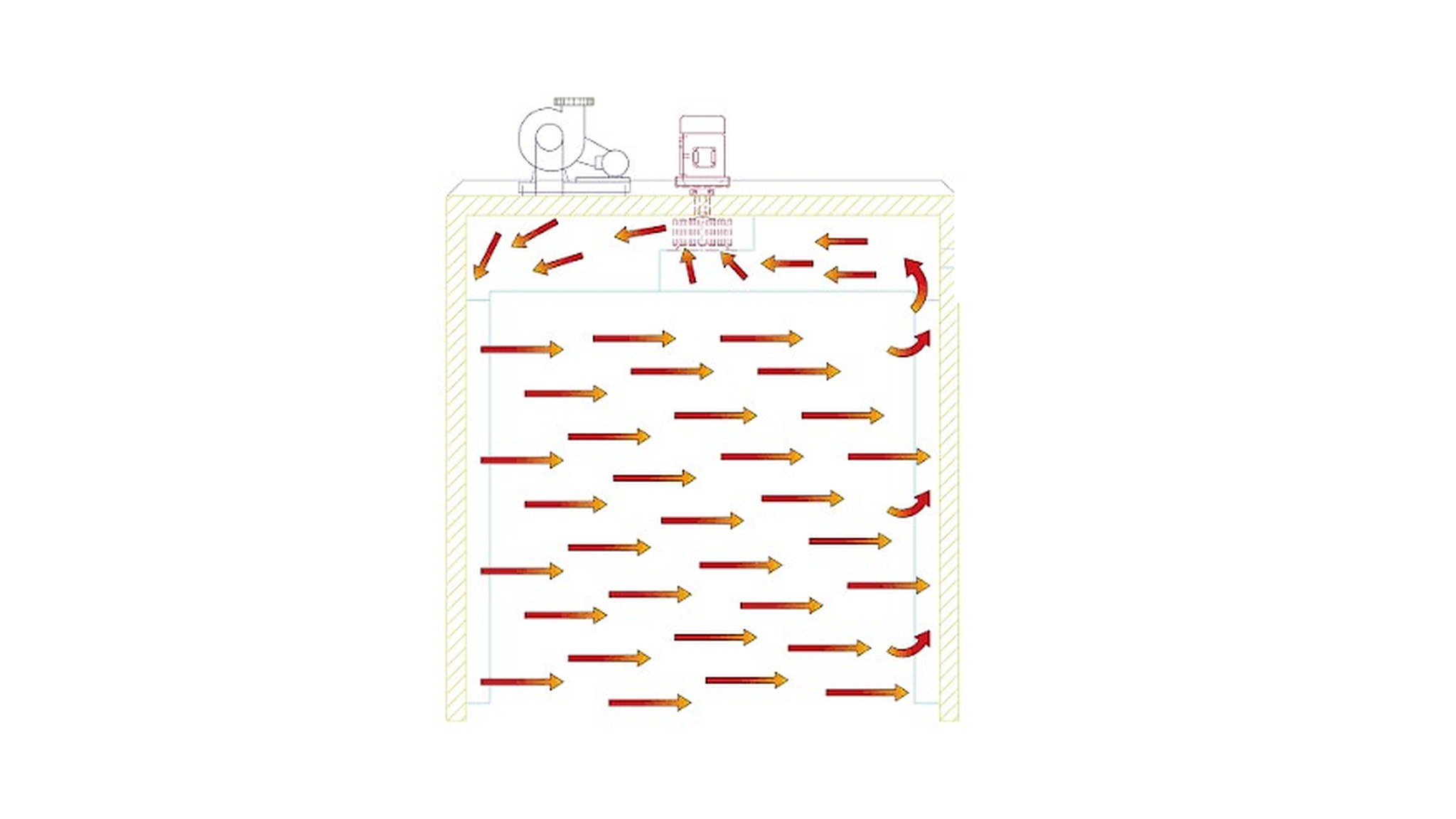
A horizontal airflow oven uses a fan to drive heated air horizontally through the working chamber. A common design supplies air from one side and returns it from the opposite side. Some models use air supply from both sides with return air collected at the back. Internal guide plates and perforated air-distribution panels help create a stable horizontal airflow pattern between the shelves.
The air-distribution structure at the supply side redistributes pressure to reduce excessive local air velocity and minimize dead zones. The return-air duct is usually located along a side wall or at the rear of the chamber, drawing air back to the heating section so it can be reheated and recirculated.
Actual airflow uniformity depends heavily on duct design, fan pressure, and the open area of the shelves. Therefore, a unit labeled “horizontal airflow” does not automatically guarantee consistent air distribution across every shelf level.
1.2 Suitable Applications for Horizontal Airflow Ovens
Horizontal airflow is a common choice for processes involving multiple loading levels. Typical applications include:
- Batch drying and curing on multiple trays or mesh shelves, such as for electronic components, small metal parts, and plastic components.
- Heat processing of flat or sheet-like workpieces placed horizontally, including PCB panels, film materials, and metal stamping parts.
- Processes that require controlled temperature differences between several loading levels through balanced airflow distribution.
Horizontal airflow is not automatically suitable for every multi-level load. Tightly stacked workpieces, solid trays without ventilation holes, or poorly designed shelf spacing can obstruct the horizontal airflow path and cause excessive temperature differences between levels or insufficient heating in local areas.
↑ Back to Table of Contents | ↑ Back to Top
2. What Is a Vertical Airflow Oven?
2.1 How Vertical Hot Air Circulation Works
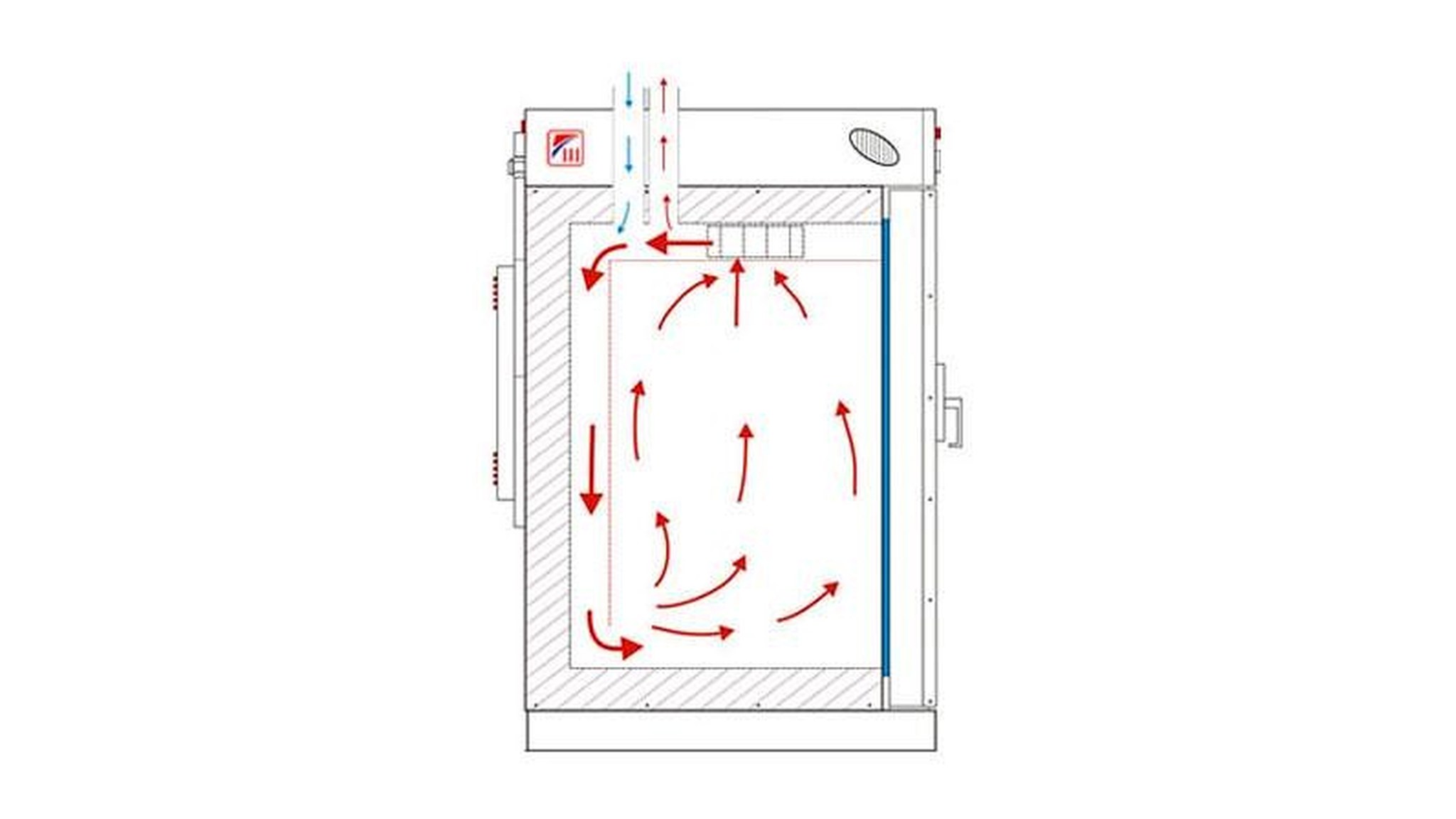
In a vertical airflow oven, hot air moves vertically through the chamber. The two common arrangements are top-down supply with bottom return, and bottom-up supply with top return. In a top-down design, an air-distribution plenum is usually installed at the top of the chamber. Heated air flows downward through the loading area and returns at the bottom. In a bottom-up design, the airflow runs in the opposite direction and may make use of the natural tendency of hot air to rise to support convection.
Unlike horizontal airflow, vertical airflow distributes air across the chamber's cross-section. In principle, the air can pass through the gaps between workpieces. In practice, however, the result depends on the supply-and-return layout and the loading arrangement. Solid workpieces or trays without ventilation holes can block the airflow. This may create turbulence around the workpiece surfaces and reduce heat-transfer efficiency.
2.2 Suitable Applications for Vertical Airflow Ovens
Vertical airflow is often a good option when the load allows air to pass through it. Typical applications include:
- Drying materials with good air permeability on perforated shelves or mesh fixtures, especially in single-layer or low-layer-count loading arrangements.
- Drying and curing suspended workpieces, such as parts on coating hooks, electroplated components, and wire products.
- Processing parts with internal passages or open structures, where airflow can enter the workpiece and help heat internal and external surfaces.
Solid trays and densely stacked flat workpieces can block vertical airflow. In these situations, a vertical design may perform worse than a well-designed horizontal system. Do not select an oven based only on the assumption that vertical airflow always provides better penetration.
↑ Back to Table of Contents | ↑ Back to Top
3. Key Differences Between Horizontal and Vertical Airflow Ovens
| Comparison | Horizontal Airflow Oven | Vertical Airflow Oven |
|---|---|---|
| Main airflow direction | Horizontally across the chamber | Vertically from top to bottom or bottom to top |
| Typical loading method | Multiple shelves or trays for batch loading | Open mesh fixtures, suspended workpieces, or certain single-layer loads |
| Risk of airflow obstruction | Dense stacking can obstruct the horizontal airflow path | Solid shelves and stacked workpieces can block vertical airflow |
| Main design focus | Side supply-and-return layout and balanced airflow between shelf levels | Top/bottom supply-and-return layout and air distribution across the chamber cross-section |
| Temperature uniformity | Depends on airflow distribution, load arrangement, and fan design | Depends on airflow distribution, load permeability, and fan design |
| What to verify | Air velocity and temperature differences at each loading level | Air penetration around and, where applicable, inside the workpieces |
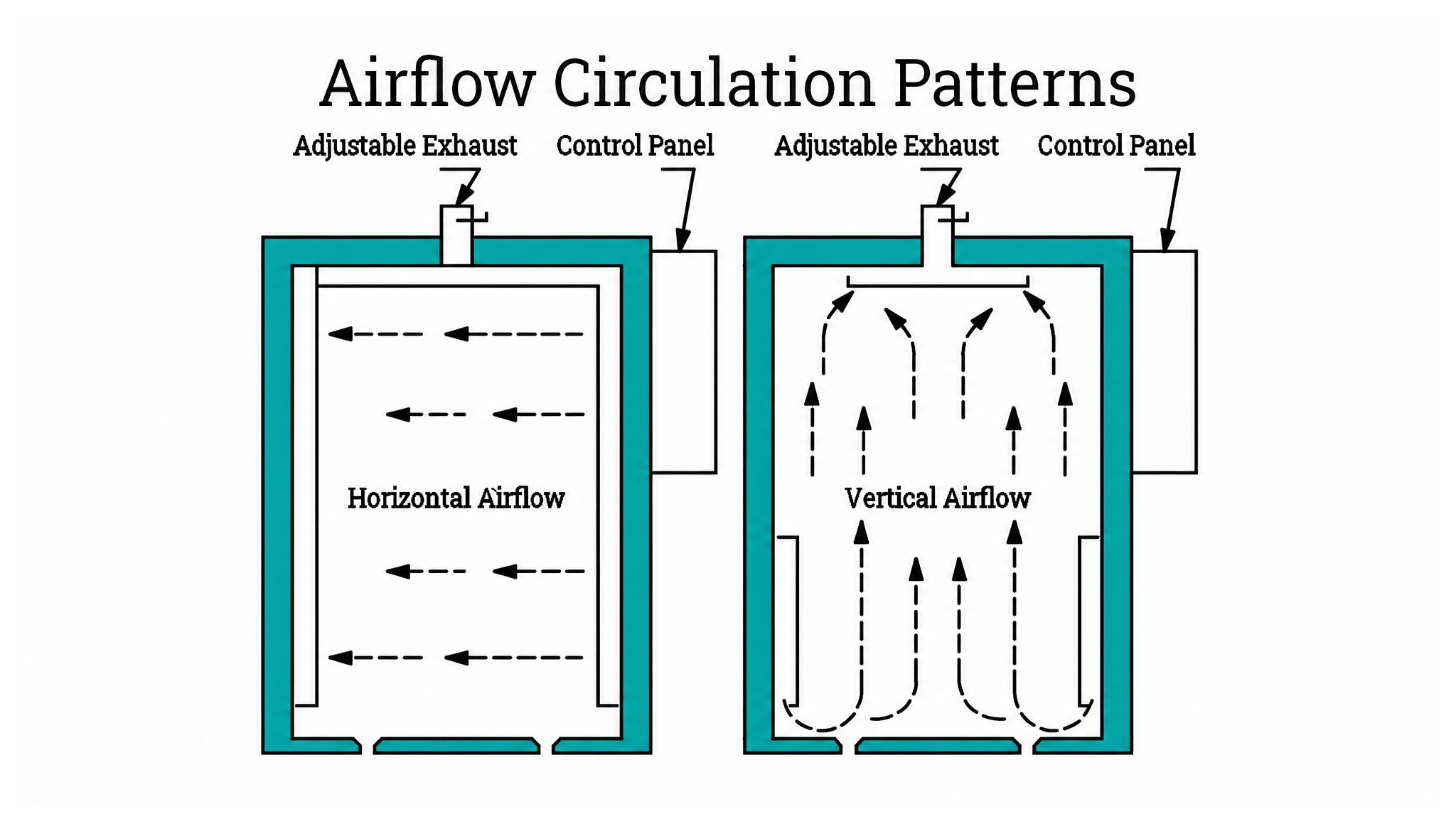
3.1 Which Airflow Pattern Provides Better Temperature Uniformity?
Temperature uniformity is determined by several interacting factors, including airflow volume, air pressure, duct design, heating power, insulation performance, and load configuration. It is not determined by airflow direction alone.
A common misconception is that vertical airflow always produces better uniformity. If the load does not allow air to pass through easily, vertical airflow may create large areas with insufficient heating. The resulting temperature differences can be greater than those in a properly designed horizontal airflow oven. The most reliable way to evaluate uniformity is to review temperature-uniformity test data obtained under simulated real loading conditions, rather than relying on the airflow label alone.
3.2 Which Design Offers Higher Drying Efficiency?
Drying efficiency also cannot be judged by airflow direction alone. Drying requires moisture or volatile substances to be removed and exhausted from the chamber. In addition to heat transfer, performance is affected by workpiece surface area, loading density, exhaust airflow, and the proportion of fresh make-up air.
For materials that allow air to pass through readily, vertical airflow may improve surface heat transfer and shorten drying time. For solid workpieces loaded densely on multiple shelves, horizontal airflow may provide more consistent hot-air contact at each level and achieve better overall efficiency. Claims about which design is more efficient are meaningful only when considered in the context of the actual process.
↑ Back to Table of Contents | ↑ Back to Top
4. How to Choose an Airflow Pattern for Your Workpieces
4.1 Products Loaded on Multiple Shelves
For batch production using multiple trays or shelf levels, a horizontal airflow oven is usually worth considering first. Check whether the shelves leave enough space for air movement, whether the trays have ventilation holes, and whether the distance between shelves matches the airflow outlet arrangement.
If workpieces are stacked high or each shelf carries a dense load, ask the manufacturer for airflow-velocity distribution data between levels. This helps reduce the risk of excessive temperature differences between upper and lower shelves or insufficient heating of parts on the bottom level.
4.2 Suspended Parts and Open Fixtures
For suspended workpieces, open fixtures, and mesh-loaded products, evaluate a vertical airflow design. Consider the orientation and spacing of the workpieces. Air penetration is generally better when the plane of a workpiece is parallel to the airflow; if the workpiece is positioned across the airflow and blocks it, the hanging arrangement may need to be changed or a horizontal airflow design considered.
For some special processes, a combined side-and-top airflow arrangement may also be evaluated to provide heating to both the surfaces and internal areas of the workpieces.
4.3 Large or Irregularly Shaped Workpieces
For oversized or irregularly shaped parts, a single airflow direction may not be enough to meet uniformity requirements. The ductwork may need to be customized. Possible measures include:
- Adding guide plates or supplementary air outlets where parts of the load obstruct airflow.
- Using a combination of horizontal and vertical airflow when the workpieces occupy most of the chamber and leave limited space for circulation.
- Carrying out airflow simulation or prototype testing in advance for particularly complex loads.
4.4 Motor Coils and Electrical Components
For drying and curing motor coils after varnish impregnation, oven selection should consider the coil arrangement, loading density, and process requirements—not just the set temperature.
If the coils are laid flat on trays in multiple layers, horizontal airflow can help heat each level consistently while carrying away volatile substances released during the process. If the coils are suspended, vertical airflow may pass more effectively through the gaps between the windings, supporting heating and curing of both inner and outer areas. There is no single airflow pattern that is mandatory for all motor-coil processes. The key is to ensure that moving air reaches the surfaces that need to be heated.

↑ Back to Table of Contents | ↑ Back to Top
5. How to Verify Oven Airflow Performance Before Purchasing
5.1 Request a Temperature-Uniformity Test Report with Defined Test Conditions
When requesting temperature-uniformity data from a manufacturer, confirm four details: the load condition during testing, the locations and number of measurement points, the set temperature and stabilization time, and the test standard used.
A uniformity figure without documented test conditions has limited value. Results obtained in an empty chamber may differ substantially from performance under a full production load.
5.2 Test the Oven Under Simulated Operating Conditions
Whenever possible, test the oven with actual workpieces or a simulated load that reflects production conditions. During the test:
- Measure actual workpiece temperatures at different chamber positions and shelf levels instead of relying only on the controller display.
- Check corners, edges, and obstructed areas for insufficient heating.
- Confirm that the oven can reach the required process temperature within an acceptable time when fully loaded.
5.3 Check the Balance Between Exhaust, Make-Up, and Recirculated Air
If the process releases moisture, organic solvents, paint or varnish vapors, or other volatile substances, the exhaust system must be evaluated. Recirculated airflow, exhaust airflow, and fresh make-up air need to be properly balanced.
Insufficient exhaust can allow volatile substances to accumulate in the chamber, reduce drying efficiency, and create potential safety risks. Excessive exhaust can waste heat, slow the temperature rise, and increase energy consumption. A well-designed equipment proposal should consider the amount of volatile material released by the process and provide suitable exhaust parameters and airflow arrangements.
↑ Back to Table of Contents | ↑ Back to Top
6. Can Industrial Ovens Be Customized with Different Airflow Designs?
Industrial ovens are often customized to meet specific production requirements, and their airflow arrangements can be designed accordingly. The process generally starts with the workpiece dimensions, shape, and loading density to determine a suitable airflow direction and duct structure. The fan, heating system, and control configuration are then selected based on production capacity, heating rate, and temperature-control requirements. For complex loads, horizontal, vertical, and combined airflow options can be evaluated.
Dongguan Xinyuanda Machinery Equipment Co., Ltd. provides customized industrial oven solutions, including airflow design based on different workpieces and process requirements. If you are unsure which configuration is suitable, share your workpiece details and process specifications with us. Our team can recommend an equipment configuration for your application.
↑ Back to Table of Contents | ↑ Back to Top
Frequently Asked Questions (FAQ)
1. Is horizontal airflow always better than vertical airflow in an industrial oven?
No. Neither design is universally better. The right choice depends on the workpiece shape, loading method, airflow obstructions, process requirements, and supply-and-return duct design. The best solution is the one that fits the actual operating conditions.
2. Which airflow pattern is more suitable for a multi-level drying oven?
Horizontal airflow is often a practical starting point for multiple shelves or trays. The final choice should still account for shelf design, workpiece spacing, and ventilation at each level so that air can circulate freely throughout the load.
3. Does vertical airflow always provide better temperature uniformity?
No. Temperature uniformity depends on fan performance, duct design, airflow distribution, insulation, heating controls, and the actual load. Test results obtained under simulated operating conditions are more useful than airflow direction alone when comparing oven performance.
Need Help Selecting an Industrial Oven?
Tell us about your workpieces, loading arrangement, target temperature, and process requirements. We can help you evaluate a suitable airflow design for your application.
Dongguan Xinyuanda Machinery Equipment Co., Ltd.
WhatsApp: +86 18998007076
Email: annalan@xudoven.com
How to Choose a Continuous Mesh Belt Furnace Manufacturer
Related Article