How to Choose a Continuous Mesh Belt Furnace Manufacturer
Mesh belt furnaces are highly non-standard, custom-engineered equipment — parameters disconnected from actual production requirements hold no reference value. This guide provides a practical supplier screening framework covering demand clarification, capability verification, cost calculation, and after-sales evaluation, helping purchasers avoid common pitfalls in the industry.
1. Define Your Production Requirements Before Contacting Manufacturers
Clarify Production Process & Workpiece Specifications
- Material, overall dimensions, unit weight of workpieces, as well as loading method and arrangement density on the mesh belt;
- Target process to be achieved (drying, curing, annealing, sintering, brazing, etc.) and finished product quality standards;
- Continuous production takt requirements, i.e. target output per hour / per shift and required pass rate.
Sort Out On-site Operating Conditions
- Rated working temperature, number of temperature zones, temperature uniformity requirements, and residence time of workpieces in the furnace;
- Heating method (electric heating / gas / thermal oil, etc.), plant energy supply conditions and power supply parameters;
- Reserved installation space in the workshop, docking mode of upstream and downstream equipment, and automation integration requirements.
2. Verify the Manufacturer’s R&D and In-house Manufacturing Capabilities
Custom Design Capability for Your Process
- Ability to clearly explain the design logic of key structures, such as temperature zone division, hot air circulation mode and mesh belt selection;
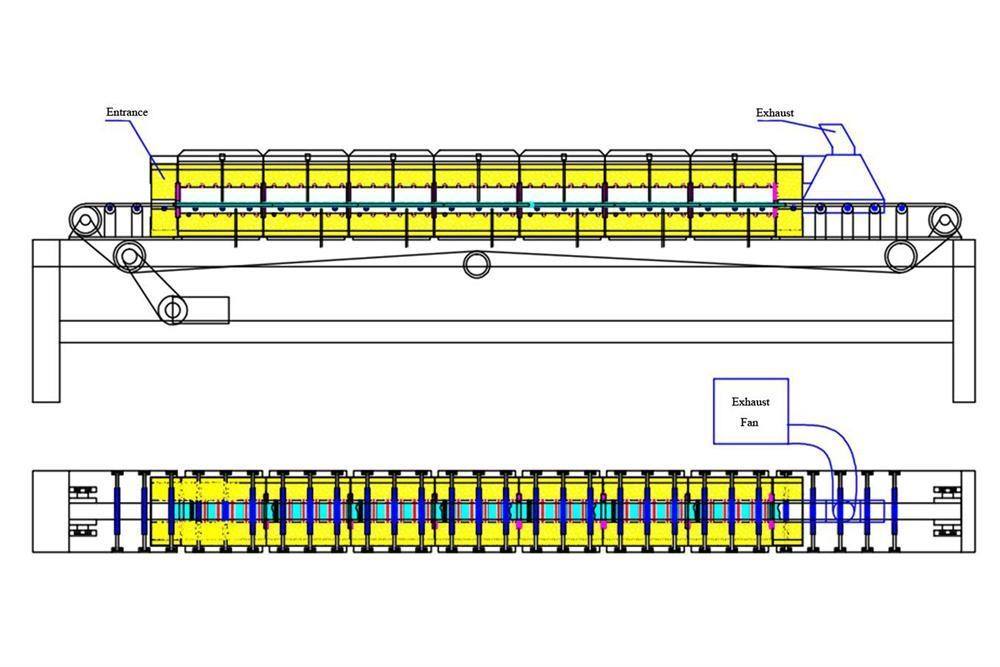
- Ability to provide full line layout drawings, detailed technical proposals and core configuration lists, rather than only brief parameter sheets;
- Custom development capability for special workpiece sizes, ultra-high/low temperature conditions, and unconventional production capacity.
On-site Production & Quality Control Capability
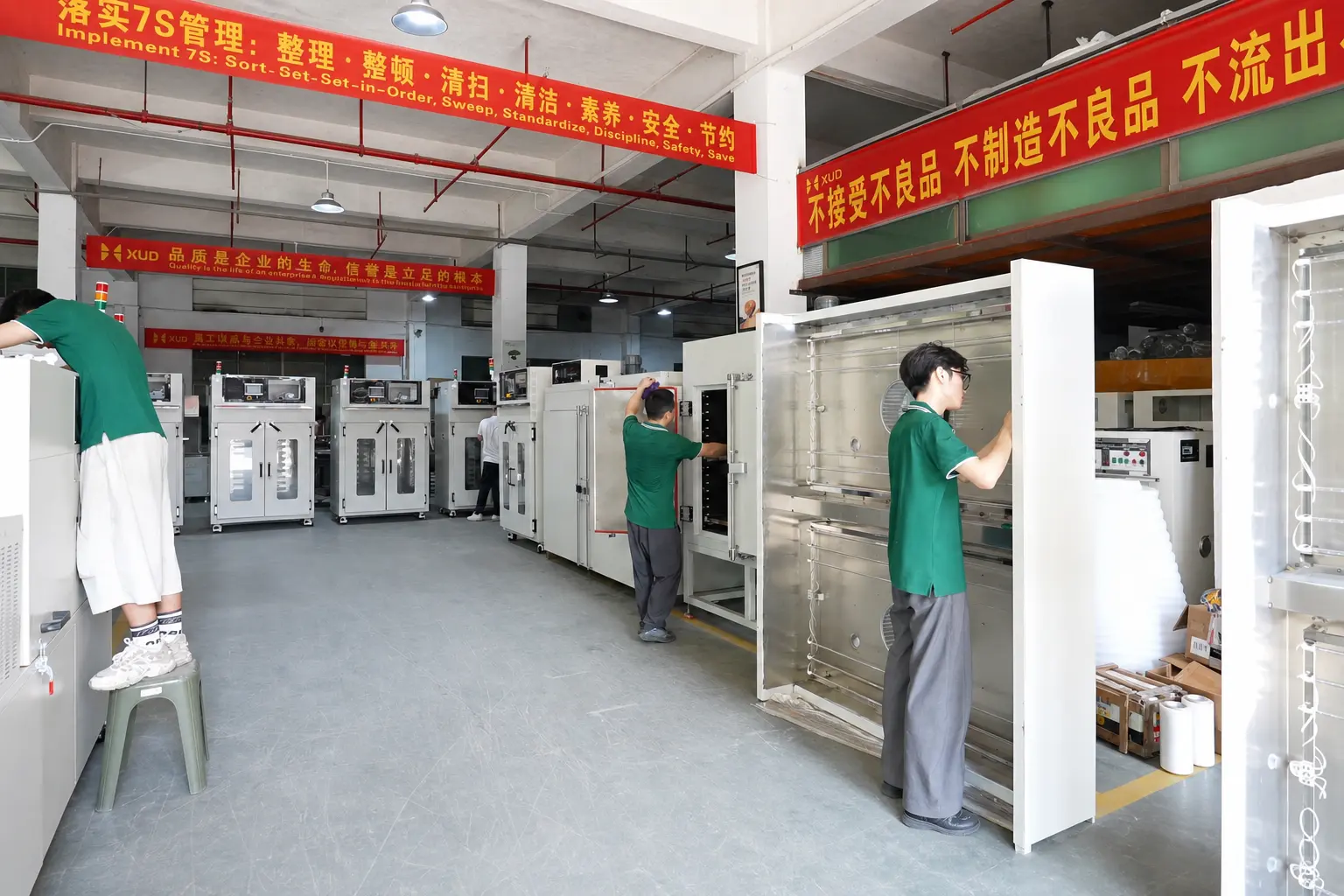
- Whether the manufacturer owns full-process workshops for sheet metal processing, welding, furnace assembly and electrical integration, instead of only outsourcing assembly;
- Procurement channels and quality control standards for core components such as heating elements, temperature controllers and drive motors;
- Ability to provide real production workshop videos, equipment assembly records, and raw data of pre-delivery commissioning tests.
Demand Solid Evidence, Not Verbal Promises
- Request real project cases in the same industry and process, with technical parameters and delivery records of corresponding equipment;
- Check whether answers to technical details are specific and consistent, rather than vague and evasive;
- On-site factory audit is recommended for qualified buyers, focusing on process details of equipment under production instead of only visiting finished product showrooms.
3. Check Quality Assurance System, FAT and Technical Documentation
Full-process Quality Control Mechanism
- Incoming inspection standards for core parts, and sampling rules for key components such as furnace linings, heating elements and mesh belts;
- In-process inspection during assembly, as well as functional test procedures for electrical safety and control systems;
- Rectification mechanism for non-conforming items before delivery, with complete traceable quality inspection records.
Standards & Scope of Factory Acceptance Test (FAT)
- Test items shall at least include: empty furnace heating-up time, furnace temperature uniformity test, mesh belt speed stability, safety interlock and alarm function test;
- All test items shall be provided with written records, including temperature curves, operation data and tester signatures;
- Support on-site witness acceptance by buyers, or remote participation via live broadcast and real-time data sharing.
Supporting Technical Documents for Delivery
- Equipment technical specification, operation & maintenance manual, electrical schematic diagram and spare parts list;
- Applicable safety standards and compliance certification documents;
- Export packing list, installation & commissioning guide, and reference standards for Site Acceptance Test (SAT).
4. Quotation Comparison: Calculate Life Cycle Cost Beyond Initial Price
Industry data shows that the initial procurement cost of continuous industrial furnaces only accounts for 28%~35% of the total Life Cycle Cost (LCC). Operating costs such as energy consumption, spare parts replacement and downtime loss account for more than 50%. Comparing only prices without aligning the quotation scope will most likely lead to higher total costs in the long run.
Align the Inclusion Scope of Each Quotation First
Quotation calibers vary greatly among manufacturers. You must align items one by one before comparison:
- Equipment main body: furnace body, control system, conveyor mesh belt system, and supporting auxiliary equipment (exhaust system, cooling section, etc.);
- Supporting services: whether packaging & transportation, on-site installation, on-site commissioning and operator training are included;
- After-sales benefits: warranty period, free wearing parts scope, rules and charges for on-site after-sales service.
Estimate Full Life Cycle Operating Cost
- Energy consumption: theoretical energy consumption under the same working conditions, and the impact of furnace insulation structure and heating control mode on actual energy consumption;
- Maintenance cost: replacement cycle and procurement cost of wearing parts such as mesh belts, heating elements and sensors, as well as daily maintenance labor input;
- Production value: equipment stability, pass rate and expected service life directly affect long-term output revenue.
| Cost Dimension | Initial Purchase Price | Long-term Use Cost (Full Life Cycle) |
|---|---|---|
| Core Composition | Main unit, standard accessories, basic packaging | Energy consumption, spare parts, maintenance labor, downtime loss, technical upgrade, residual value |
| 10-year Cycle Share | 28%~35% | 65%~72% |
| Decision Impact | Short-term budget expenditure | Long-term profit and operational risk |
5. Evaluate After-sales Service & Long-term Technical Support
A reliable manufacturer builds its after-sales system into predictable service standards, rather than negotiating ad-hoc solutions after problems occur.

Installation, Commissioning & Operation Training
- Whether on-site installation guidance and full-process commissioning support are provided, or only remote guidance;
- Whether systematic training on operation specifications, daily maintenance and common troubleshooting is covered;
- Communication channel for daily technical issues, response time and resolution mechanism for remote support.
Spare Parts Supply & Daily Maintenance
- Supply channels and delivery lead time of wearing parts and key spare parts (mesh belts, heating tubes, thermocouples, motors, etc.);
- Warranty coverage, exemption clauses, and charging standards for out-of-warranty maintenance services;
- Whether long-term maintenance services such as regular inspection and equipment upgrading are available.
Exclusive Support for Overseas Buyers
For cross-border procurement, additional confirmation is required:
- Cross-time zone communication capability, multilingual technical documents and docking support;
- Export packaging compliance, and supporting capacity for shipping / customs clearance documents;
- Coordination capability for overseas on-site installation & commissioning, and technical support for future production expansion.
6. Direct Manufacturer vs Trading Company
Many overseas buyers struggle between "original factory or trader". There is no absolute advantage or disadvantage. The core is whether technical responsibility, production responsibility and after-sales responsibility are clear and traceable.
| Comparison Dimension | Direct Manufacturer | Trading Company |
|---|---|---|
| Technical Design | Led by in-house engineering team, fully customizable | Mostly forward factory solutions, weak technical explanation |
| Production Execution | Full-process in-house control, stable quality standard | Outsourced production, inconsistent quality standards |
| Custom Demand Response | Direct production docking, fast response | Layer-by-layer relay, high communication cost & error rate |
| Quality Issue Handling | Direct root cause location, high rectification efficiency | Need to coordinate upstream factories, vague responsibility |
| Spare Parts & After-sales | Original spare parts supply, precise technical support | Unstable spare parts channels, long after-sales cycle |
7. How to Choose the Right Manufacturing Partner
Choosing a continuous mesh belt furnace manufacturer is essentially choosing a long-term process partner. The core evaluation lies in four dimensions:
- Whether the equipment design truly matches your production process, instead of a modified standard model;
- Whether manufacturing capability and quality control are verifiable, supported by real production records and test reports;
- Whether technical specifications, quotation details and delivery responsibilities are transparent, without hidden vague clauses;
- Whether installation support, spare parts supply and long-term maintenance responsibilities are clear, with guaranteed cross-border service capability.
As a professional manufacturer focusing on industrial thermal equipment, Dongguan Xinyuanda Machinery Equipment Co., Ltd. has independent R&D and full-process production capacity. We provide customized continuous mesh belt furnace solutions tailored to customers' workpiece features, process requirements and plant conditions. We welcome customers to visit our production site, verify project cases and participate in factory acceptance with full transparent communication.
If you have mesh belt furnace procurement needs, please send us your workpiece information and production requirements. We will provide you with professional process evaluation and a detailed quotation.
Frequently Asked Questions (FAQs)
1. How to choose a reliable continuous mesh belt furnace manufacturer?
Judge from five core dimensions: first, engineering design capability; second, manufacturing evidence with real workshops, assembly processes and similar project cases; third, quality control with standardized FAT and traceable inspection records; fourth, after-sales system with clear spare parts supply, technical support and maintenance mechanisms; fifth, quotation transparency with verifiable configurations and service scope.
2. What information is needed to request a mesh belt furnace quotation?
Basic information includes: workpiece material, target processing technology, hourly output target and operating hours, heating method, and on-site conditions such as plant power / gas supply.
3. How to verify if a mesh belt furnace supplier is a real manufacturer?
You can request: real-time production workshop videos (focusing on sheet metal, welding, assembly processes), process records of equipment under production, technical design drawings and electrical schematics, and original FAT reports. On-site factory audit is recommended to verify the authenticity of production sites, equipment and engineering teams.
4. What factors affect the price of continuous mesh belt furnaces?
Main factors include: equipment specifications (furnace length, mesh belt width), number of temperature zones and maximum working temperature, mesh belt material and conveyor system configuration, heating method and control system grade, automation integration level, and auxiliary configurations such as exhaust and cooling systems. In addition, services such as installation, training and warranty will also affect the final quotation.
Contact Us
Company: Dongguan Xinyuanda Machinery Equipment Co., Ltd.
Address: No.29 Getang Road, Xiegang Town, Dongguan City, Guangdong Province, China
WhatsApp: +86 18998007076
Email: annalan@xudoven.com
Website: www.xudoven.com
Hot Air Oven Temperature and Time
Related Article