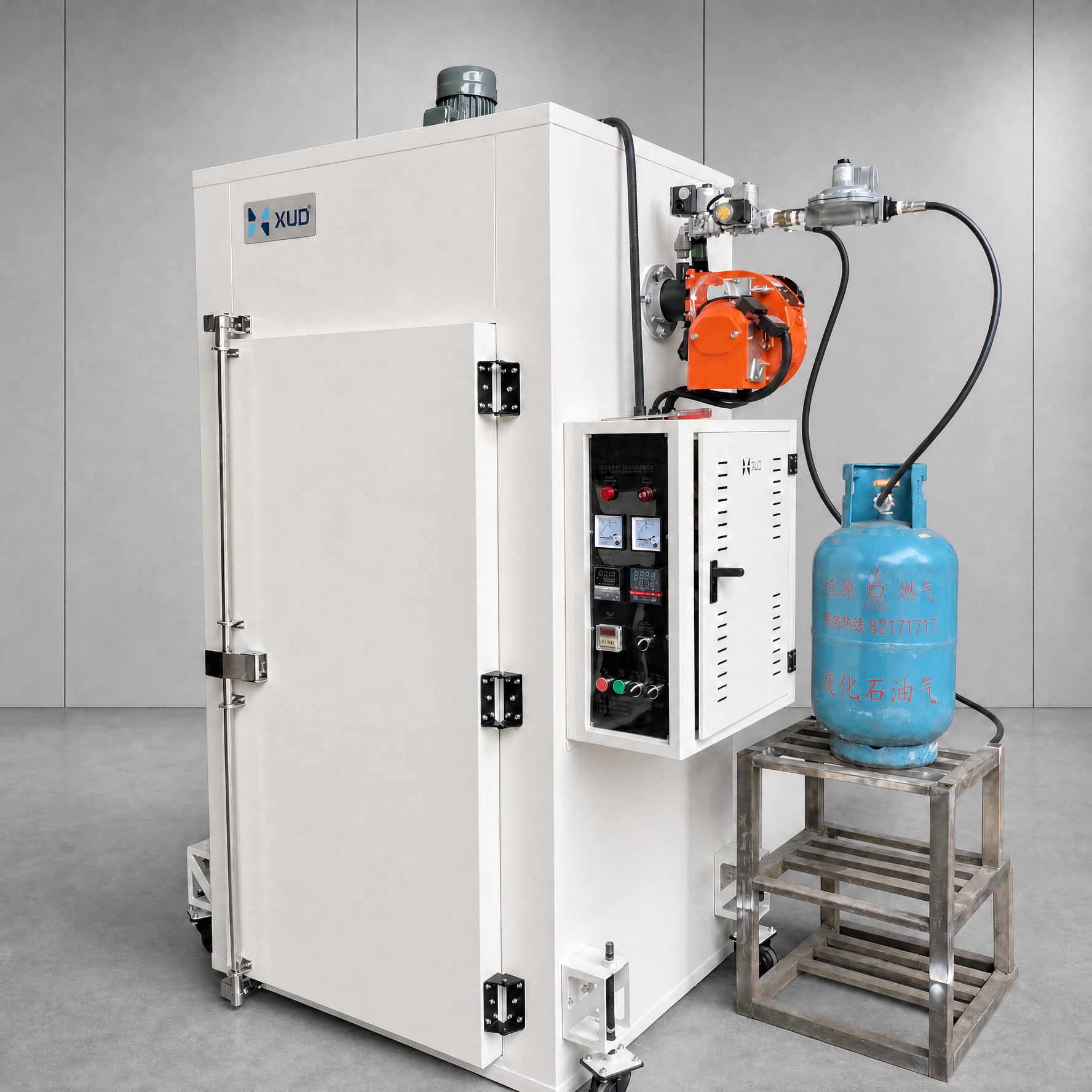
Industrial Oven for Motor Coil Varnish Drying and Curing
If you’ve ever wondered why a motor fails prematurely, the root cause often traces back to the varnish drying and curing step. Varnish locks copper windings in place, dampens vibration, and blocks moisture and contaminants that erode insulation over time. Industry testing data shows that poorly cured varnish can reduce winding insulation service life by 30% or more — turning precision-engineered parts into costly warranty claims.
There is no one-size-fits-all cure cycle. Final results always depend on varnish chemistry, coil geometry, stator frame size, and each manufacturer’s process specifications. Choosing the right industrial oven is never about picking a standard metal box; it’s about matching thermal performance to your actual production needs. At Dongguan Xinyuanda Machinery Equipment Co., Ltd., we build ovens around your process, not the other way around.
Why Is Controlled Drying and Curing Important for Motor Windings?
First, controlled heating removes volatile solvents from the varnish film at a steady rate. Rush the process with excessive heat, and you get blistering, pinholes, or surface skinning that traps solvents underneath — all of which directly weaken dielectric strength.
Second, uniform chamber temperature ensures the varnish polymerizes fully and consistently across every coil in the batch. For most solvent-based insulating varnishes, ±5°C temperature tolerance is the industry baseline; tighter ±3°C control delivers more predictable hardness, adhesion, and long-term thermal endurance.
Third, batch-to-batch consistency cuts rework and scrap rates. Uneven airflow can create 10–15°C cold spots inside the chamber, leaving some coils over-baked and others under-cured in the same load. For high-volume motor plants, this typically translates to 5–10% higher scrap and rework rates that eat into margins.
Too much heat also degrades wire enamel and slot insulation paper; too little, and the resin never fully cross-links. In short, controlled curing is not a nice-to-have — it is the foundation of motor reliability.
How Does a Motor Coil Varnish Drying Oven Work?
A standard batch curing cycle runs in three managed stages.
Stage 1: Loading
First, loading: coils or stators are placed on racks or trolleys, with reserved airflow clearance around each part. Blocked air channels are the single most overlooked cause of uneven curing on production floors.
Stage 2: Heating and Soaking
Second, heating and soaking: electric or gas heating elements warm the chamber air, while high-volume circulation fans (2–3 m/s typical air velocity) distribute heat evenly throughout the working zone. 3–6 temperature sensors per standard chamber feed real-time data back to the controller, which adjusts heat output to maintain the setpoint accurately.
Stage 3: Optional Gradual Cooling
Third, optional gradual cooling: some processes call for controlled cool-down before unloading to prevent thermal shock to windings. Advanced oven models store full cure recipes — ramp rates, soak durations, and cool-down steps — so every batch runs exactly the same way.

Batch Oven or Multi-Door Oven for Motor Winding Production?
Your choice comes down to production volume, part variety, and line flow.
Single-door box ovens are ideal for low-to-medium volume and high-mix production. They work with standard loading trolleys and typically handle 50–200 stators per batch, depending on frame size.
Multi-door ovens shine in steady high-volume operations. Each door serves an independent heating zone, so you can stage batches sequentially without shutting down the entire unit. In practice, multi-door configurations boost throughput by 30–40% compared with a single-door oven of equal total volume.
You should also weigh one large oven against multiple smaller units. A single large unit has lower cost per cubic meter and simpler utility hookups, but offers less flexibility. Multiple smaller ovens provide production redundancy and support simultaneous different cure cycles, but require more floor space.
Our practical rule: prioritize flexibility if your product mix shifts more than twice a month; prioritize throughput if you run the same part 16+ hours a day.
Key Specifications to Consider
Before requesting a quote, clarify these core specs to avoid misalignment:
| Chamber Size & Usable Space | Account for batch quantity, fixture dimensions, and 100–150 mm of airflow clearance on all sides. |
| Temperature Performance | Most varnish cures run 120–180°C; look for ±3–5°C uniformity verified by a standard 9-point temperature mapping test. |
| Heating, Airflow & Exhaust | Plan for roughly 2–3 kW of heating power per cubic meter for 200°C maximum temperature. Size exhaust capacity to safely remove solvent vapors per workplace safety standards. |
| Controls & Safety | PID temperature control is standard; PLC with touchscreen and data logging is recommended for quality traceability. Over-temperature protection and door safety interlocks are non-negotiable. |
| Heat Source | Electric heating is clean, precise, and easy to install for assembly areas. Gas-fired heating reduces energy costs by 25–35% in most regions, making it popular for 24/7 high-volume plants. |
Custom Industrial Oven Solutions for Motor Manufacturers
At Dongguan Xinyuanda Machinery, we design each oven around your specific parts, production volume, and factory conditions. Available custom options include chamber dimensions, trolley/rail/rack loading systems, optimized airflow patterns, PLC control with recipe storage, and your choice of electric, natural gas or LPG heat sources.

We publish clear, measurable performance specifications for temperature uniformity, heat-up time, and energy consumption. We do not make vague claims about “guaranteed cure results” — curing outcomes depend on your varnish formulation, part mass and cycle settings. What we do guarantee is consistent, repeatable thermal conditions batch after batch.
Frequently Asked Questions
Q: What information is needed to select a motor winding oven?
A: Part dimensions and weight, batch quantity per load, target cure temperature and time, preferred heat source, and available factory floor space. Photos of your current loading setup also help us optimize airflow design.
Q: Can the oven temperature profile be customized?
A: Yes. All our ovens support programmable ramp rates, multiple soak stages, and adjustable cool-down. You can store multiple recipes for different varnish types or motor models.
Q: How can temperature uniformity be evaluated?
A: We perform a standard 9-point empty-chamber temperature mapping test before delivery. For production conditions, we recommend periodic loaded-chamber mapping to verify real-world performance.
Q: Should I choose a single-door or multi-door oven?
A: Choose single-door for production flexibility, frequent product changeovers, and lower initial investment. Choose multi-door for high-volume, continuous production where minimizing idle time between batches is critical.
Ready to Match the Right C
what is hot air oven